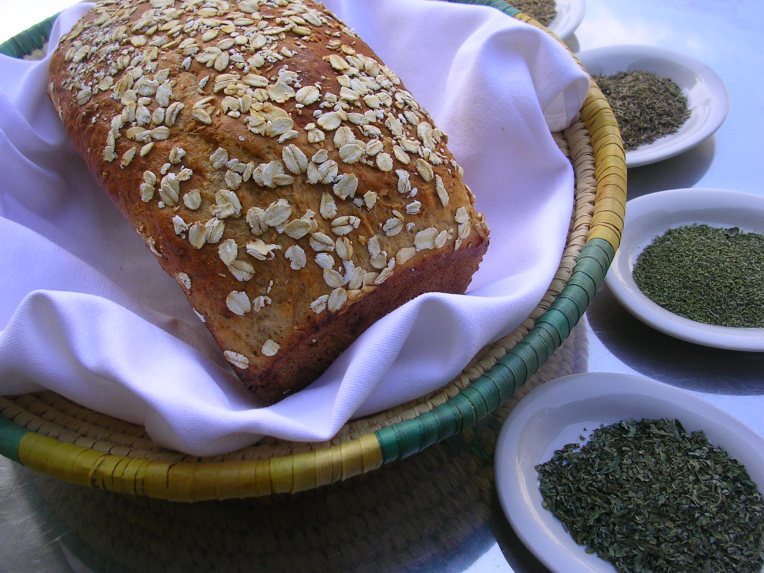
 Once my daughter brought a friend home for the weekend, who saw me baking bread. A few days later her friend sent us a lovely thank-you note with a watercolor view from our kitchen window and her grandfather’s recipe for oatmeal herb bread (typed on an antique manual typewriter). Almost every time when I try out a new bread recipe and ask my husband whether he likes it, he says, “It was good,” or “It was great,” only to add, “but I still like Claire’s bread the best.”
Claire’s bread is the reason why I started to grow summer savory, an herb I rarely use in cooking. I grow savory from seed until it’s strong and bushy and about to bloom, then I cut it down all at once and dry it. By late winter, the savory supply is gone, so my husband has to wait until mid-summer for more of his favorite bread. Even my son, until now a member of the Wonder Bread lobby, said it was good.
I made a few changes to the original recipe, including honey instead of molasses, whose flavor I don’t like; whole-wheat flour plus gluten for a lighter texture; more savory and no dried parsley. Like all bread, it should cool completely before cutting. This is not easy to enforce if you have a bread lover lurking in the kitchen, just waiting for you to turn your back.
Whole-Wheat Herb Bread I
2 scant tablespoons active dry yeast
1/3 cup lukewarm water
2 tablespoons soft butter
½ cup dark honey
3 cups whole-wheat flour (preferably King Arthur white whole wheat flour)
3 cups bread flour
2½ teaspoons salt
4½ teaspoons gluten
2 cups hot water
1 cup rolled oats
1 teaspoon finely crumbed dried crumbled basil
½ teaspoon anise seed
2½ teaspoons powdered summer savory
½ teaspoon finely crumbled dried thyme
1 egg
1. Dissolve the yeast in the lukewarm water and let stand 10 minutes until foamy.
2. In the meantime mix the butter with the honey in a small bowl. Mix the flours with the salt and gluten in a large mixing bowl, or the bowl of a stand mixer. Add the hot water and mix briefly.
3. Add the yeast mixture and the butter-honey. With the kneading attachment of the electric hand mixer, or with the stand mixer with kneading hook set on low, knead until a smooth dough forms. If the dough is too dry, add a little warm water; if it’s a little tacky, don’t worry and please don’t add more flour, otherwise the bread will be too dry.
4. Lightly oil a large bowl and place the dough in it. Turn the dough over once so it is evenly coated and cover with a kitchen towel. Let rise in a warm place for 1 hour.
5. Reserve 2-3 tablespoons of the oats and work the rest into the dough together with the dried herbs until well incorporated.
6. On a floured surface divide the dough into two equal pieces. Place them in greased loaf pans and cover with a kitchen towel. Let rise in a warm, non-drafty place for 45 minutes.
7. Preheat the oven to 350 degrees F.
8. Mix the egg with 2 tablespoons cold water and brush onto the tops. Sprinkle with the reserved oats.
9. Place a jelly roll pan the lower rack of the oven. Fill it two-thirds with boiling water from a water kettle.
10. Bake 40 to 50 minutes until browned on top. If the bread makes a hollow sound when you knock on the bottom, it’s ready. Remove from the pan and let cool on a cake rack.
Makes two loaves
Whole-Wheat Herb Bread II (Sourdough Version)
Starter:
¼ cup fed starter
1 cup bread flour
½ cup lukewarm water, more as needed
Dough:
2 tablespoons unsalted butter, softened
2 tablespoons honey
3 cups whole-wheat flour
2 cups bread flour
2½ teaspoons salt
2 cups hot water
1 teaspoon finely crumbed dried crumbled basil or rosemary
½ teaspoon anise or fennel seed, crushed
2½ teaspoons powdered summer savory
½ teaspoon finely crumbled dried thyme
Everything but the Bagel Seasoning, for sprinkling
1. Mix starter ingredients in a container with a tight-fittig lid. Cover and let sit at room temperature for 12 to 14 hours.
2. Mix the butter with the honey in a small bowl. Mix the flours with the salt in a large mixing bowl, or the bowl of a stand mixer. Add the hot water and mix briefly.
3. Add the starter mixture, butter, and honey. With the kneading attachment of the electric hand mixer, or with the stand mixer with kneading hook set on low, knead 3 min on low, then 2 minutes on medium speed.
4. Lightly oil a large container with a tight-fitting lid and place the dough in it. Turn the dough over once so it is evenly coated and cover with a large plate and a damp kitchen towel. Let rise in a warm place for 2 hours, folding and stretching after 1 hour.
5. Divide the dough into two equal pieces. Place them in greased loaf pans press them down gently with wet hands to fill the pan. Cover with a kitchen towel and let rise in a warm, non-drafty place for 1.5 hours, or until the dough has reached the sides of the pan.
6. Preheat the oven to 400 degrees F.
7. Make 3 to 4 diagonal cuts in each loaf in opposite directions to create a diamond pattern. Lightly brush the surface with water and sprinkle with seasoning mix. Place breads in center rack of oven at once.
8. Bake for 40 minutes at 400 degrees F, then remove bread from pans. Place the loaves directly on the oven rack and bake for another 15 minutes to brown all around.
9. Remove from the oven and let cool for several hours on a wire rack before cutting.
Makes two loaves

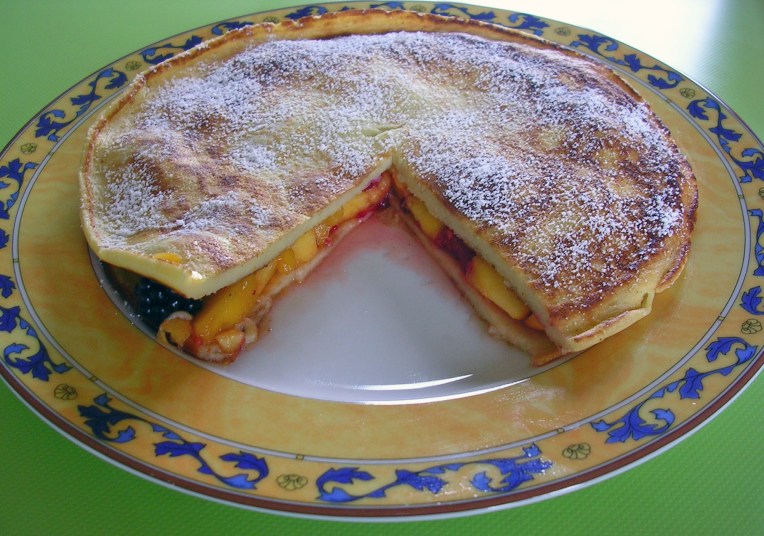 In food, like in so many other areas, everything is typically bigger in the United States than in other countries. Pancakes are one of the few exceptions. German pancakes, the kind my grandmother fed me for lunch (unlike in America, pancakes are usually not eaten for breakfast in Germany), are as large as a dinner plate. They are thicker and quicker to prepare than French crêpes. Because they are so large, they are easily filled and rolled up.
 Yesterday I went on a tour of the Rodale Institute and came home fully charged with new ideas. But today is a dreary, rainy Sunday – a perfect day to take care of what’s already there: the first big batch of tomatoes for sauce.
 Green Card Gardener