No eggplant left behind

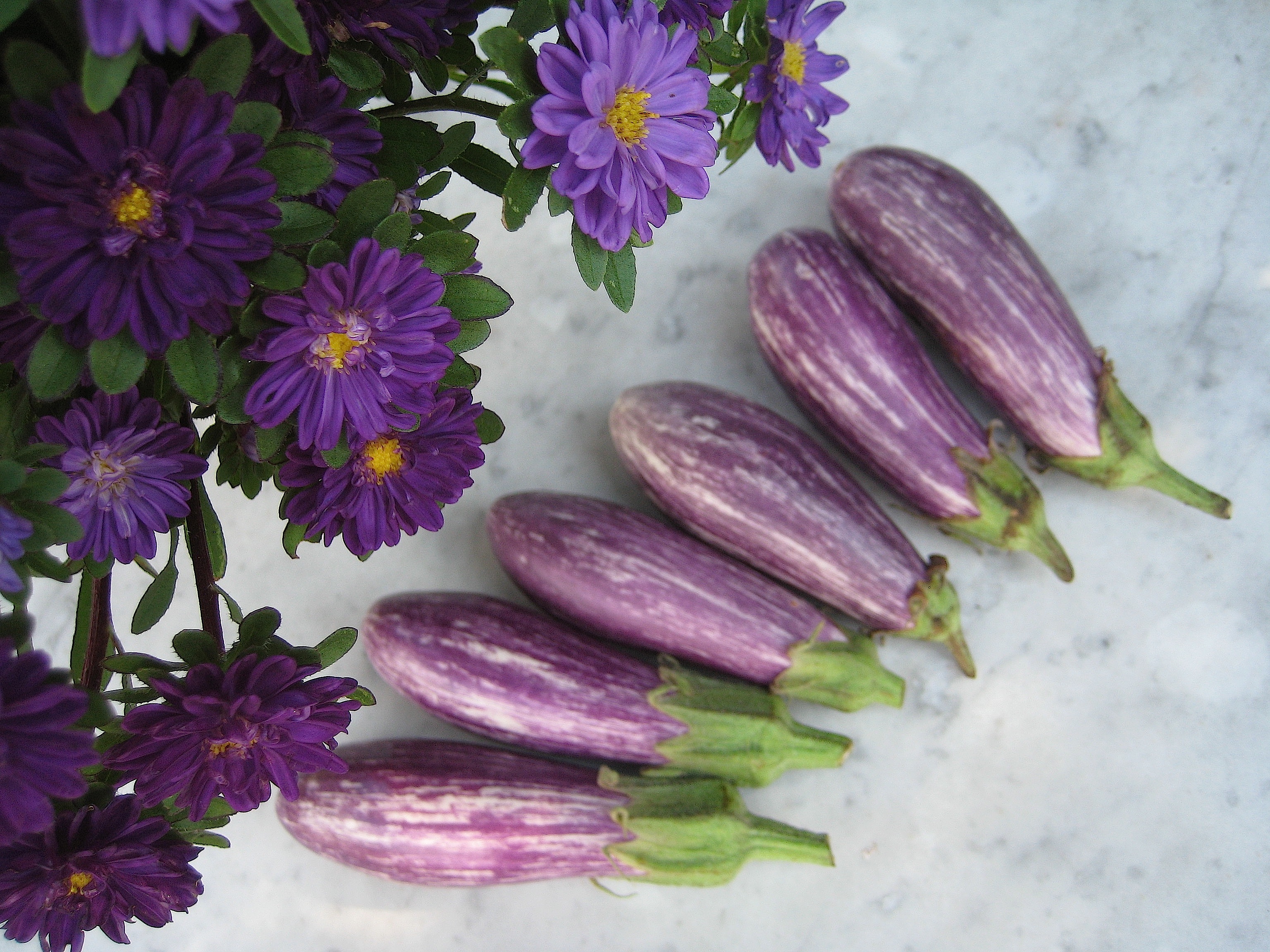
As the nights are getting chilly, the skin of the delicious Fairytale eggplants toughens. A few days ago the eggplants melted in your mouth. Now you can still eat them whole, and they are still good, but they are not at their peak any more.

I picked my six plants clean and used the larger ones for a dip adapted from Deborah Madison’s excellent Roasted Eggplant Dip with Dill, Yogurt, and Walnuts, which I like better than traditional Baba Ghannoush with tahini. As eggplants and eggplant skins are a good addition to vegetable broth (here is my recipe), that’s where all the other tiny eggplants are going.

Not a single eggplant left. I will for sure grow those again next year!
Fairytale Eggplant Dip with Dill

Adapted from Vegetarian Cooking for Everyone by Deborah Madison

There is more waste from all the skins of the small Fairytale eggplants, therefore I started with a full 2 pounds of eggplant instead of the 1 1/4 pounds in the original recipe. Also, I always throw in a handful of dill fronds (all tough thick sprigs removed) instead of chopping the dill, as everything gets finely pureed in the food processor anyway.

2 pounds Fairytale eggplants

Olive oil

1/3 cup walnuts

3 garlic gloves

1 handful of fresh dill fronds

3 tablespoons extra-virgin olive oil, more for pouring onto the dip

1/2 cup Greek yogurt (I used 0%)

Salt

Freshly milled black pepper1. Preheat the oven broiler and set the rack about 5 inches from the heat.

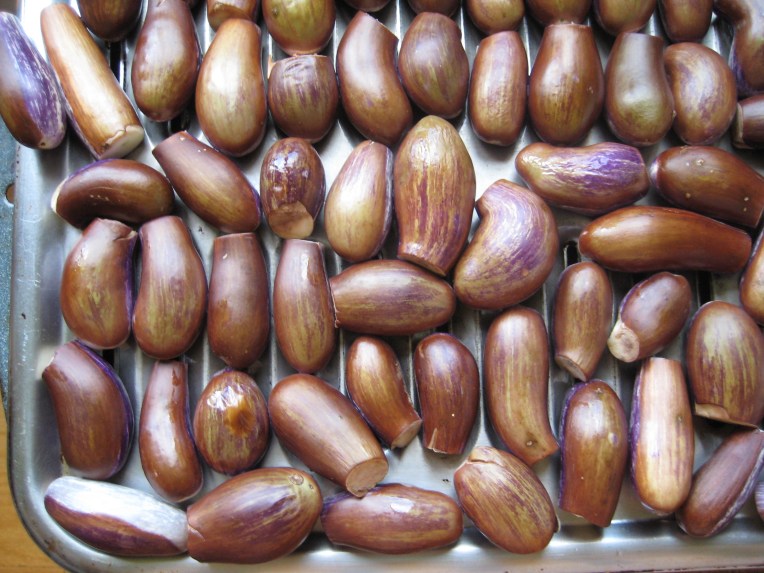
2. Cut the blossom ends off the eggplants. Put the eggplants in a large bowl and toss them with a little olive oil to coat evenly. Distribute them evenly in one layer on a roasting pan and place them under the broiler. Stand by closely, they turn brown very quickly. Once the tops have slightly charred, turn them and broil from the other side. Test one eggplant to check if the skin can be easily removed; if not, let the skins char some more, turning the eggplants as needed. Remove from the oven and cool slightly.

3. As soon as the eggplants are cool enough to handle, remove the skins. The easiest way to do this is by making an incision along the length of each eggplant and flap it open. Collect the pulp in a bowl and set aside to cool.

4. Lightly toast the walnuts in an non-greased pan. Let cool, then place it in the food processor, together with the eggplant pulp and all the other ingredients. Puree to a fine consistency and salt and pepper to taste. Alternatively, you can also puree the dip with a stick blender if the bowl is large enough to hold all the ingredients. Scoop the dip into a container with a tight-fitting lid and pour a little extra-virgin olive oil on top to prevent it from drying out. Refrigerate. Serve at room temperature, stirring well to smoothen before serving. The dip keeps in the refrigerator for 4 to 5 days.
Color, after all

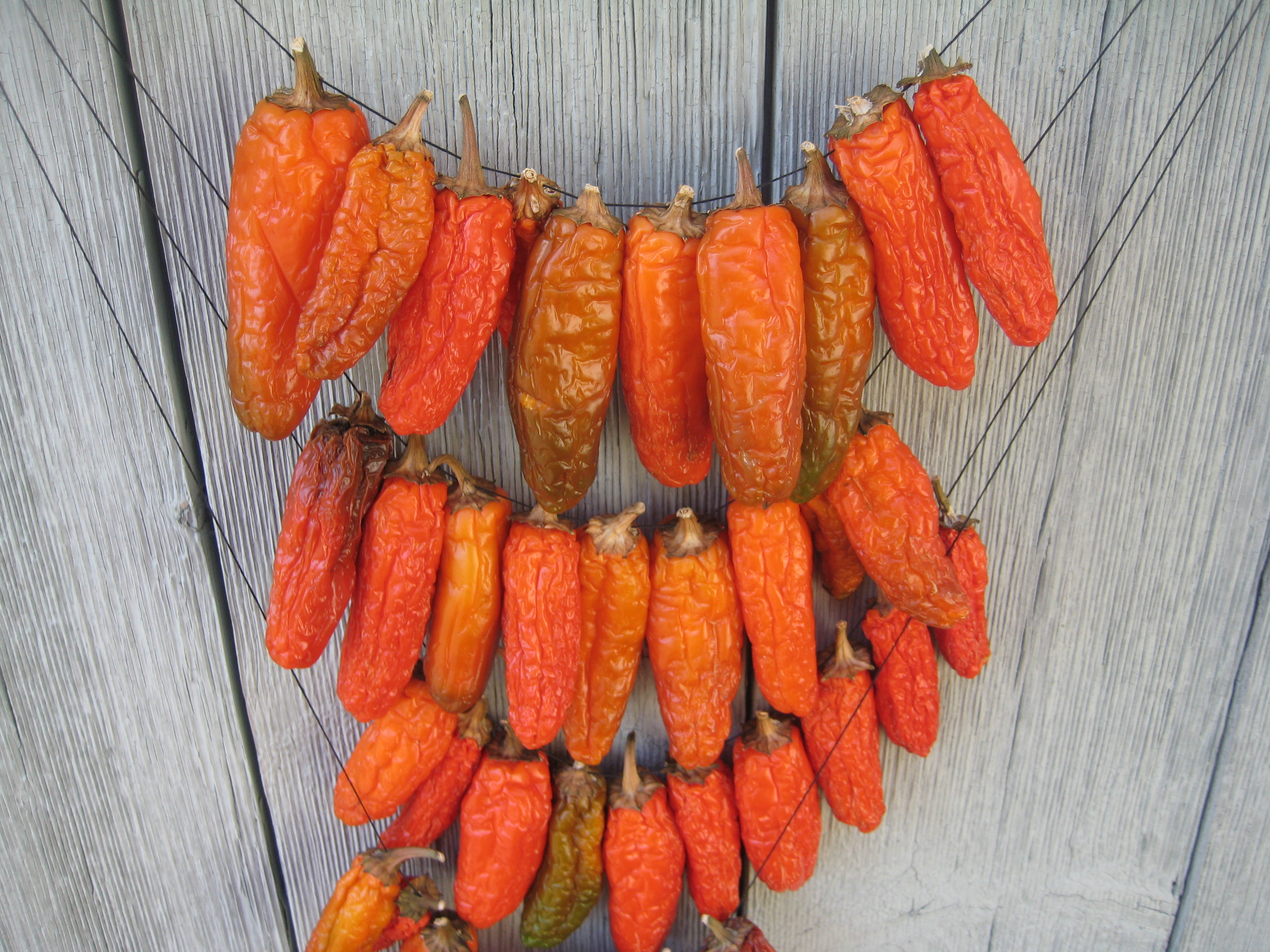
I was too quick concluding that the jalapeños from the garden I hung up for drying are not changing color – they are. On sunny days I put them out every morning, move them with the sun in the afternoon, and bring them in at night. That might sound quite involved but what wouldn’t I do for a good, homemade harissa?

The harissa that comes in small cans like tomato paste or tubes is awful – it is nothing but hot. The real stuff for me is harissa berbère. It is based on sun-dried chilis and blended with garlic and spices. When I lived in Tunis, one of the highlights of my week was shopping at the Marché central on Saturdays. I would always buy a glob of harissa berbère, which was sold in bulk from a large mound sitting out in the open. The spice merchant would scoop off a glob onto a piece of wax paper. I usually could not wait to spread it thickly on fresh flatbread with nigella seeds, another one of my favorites. When I told my aunt that I bought harissa in bulk at the market, she was appalled. I never got sick.

It will be a while before the chili peppers are ready but I already have my harissa recipe lined up. Unfortunately I don’t have my Tunisian grandmother’s recipe. This is as close to hers, and other genuine harissa berbère, as I could get it.

Harissa

Basically you can use any red chili peppers you like. The more seeds you remove, the milder the harissa will be. I usually remove most of the seeds. Wear disposable gloves when handling the chilis. Harissa keeps for several weeks in the fridge.

12 dried red chili peppers

1 tablespoon plus ¼ cup extra-virgin olive oil, more for pouring on top

3 cloves garlic, peeled and finely chopped

½ teaspoon coarsely ground caraway seeds

½ teaspoon coarsely ground cumin

½ teaspoon coarsely ground coriander

Kosher salt to taste

1. Remove the stems from the peppers. Cut them in half and remove all or some of the seeds. Put the peppers in a small heatproof bowl. Pour boiling water over them, just enough to cover. Press the peppers into the water and soak for a few minutes.

2. In the meantime heat 1 tablespoon olive oil in a small skillet. Add the garlic and spices and cook over medium heat until fragrant. Stir often and make sure the garlic does not brown. Remove from the heat and let cool.

3. Drain the chilis and place them in the food processor with all the other ingredients. Process in a food processor or blender to a coarse or fine consistency according to taste. Season with salt and fill in a sterilized glass jar. Smoothen the top and pour additional olive oil over it to prevent harissa from drying out, and refrigerate.

Of mice and fairytales

Fairytale eggplant and asters

On Sunday I barely missed what would have been my most traumatic gardening experience. The pole beans on the first two teepees needed picking, and since the vines had started to form such a thicket I asked my husband to come along to lift the vines while I cut off the beans.

When I had quickly harvested some beans for dinner the week before I had noticed a nest made of newspaper scraps almost at the top of one of the tepees. Smart birds, I thought, taking the newspaper mulch from around the tomato plants, and I simply picked around it.

The nest soon started to get in our way when we were picking on Sunday so I suggested we check if it still had anything inside. My husband took it down and instantly threw it over the garden fence down the hill.

“What was it?” I asked.

Pause.

“Tell me.”

“You would have screamed so loud all our neighbors would have called 911. It was a mice nest. One of them was looking straight at me.”

He was not exaggerating. Mice and other rodents, dead or alive, small or large, freak me out in capital letters. Living in the country for more than a decade has not diminished my phobia, on the contrary.

I know there are always mice around outdoors, but as long as I don’t see them or their traces, I can manage. But sticking my face into a nest and having a mouse stare at me would have been too much. If I had taken down that nest, I am sure I would have had such a shock that I most likely would have had a hard time setting foot in the garden for a good long time.

Upon my insistence we stripped the teepee of all the vines and cut off all harvestable beans. Now when I go to the garden, I clap my hands several times before opening the gate. I know it sounds ridiculous but it makes me feel better.

To end this post on a more positive note, the China asters that I planted as cutting flowers are blooming. I gave them a sheltered home inside the garden to protect them from voracious rabbits.

And, I have started to harvest Fairytale eggplants! I fell in love with those beauties at Field to Fork, an event I organized last year in August with the Master Gardeners. Designed to inspire more people to garden, we grew different fruits and vegetables in containers. One member of the group had Fairytale eggplants and I couldn’t wait to try them myself.

Fairytale eggplants are hybrids, meaning a cross breed between two parent plants. Unlike heirlooms, you cannot collect the seeds for next year. Frankly I do not understand the hype about heirlooms, and the demonization of hybrids that often goes hand in hand with it. Mankind has been breeding plants for thousands of years. If plant hybridization gives you crops that are resistant to a disease or a pest, and/or yield a result as delicious and beautiful as Fairytale, what’s the big deal? I think one of the reasons why hybrids are often shunned is that some people confuse them with genetically modified organisms (GMO’s). They are not. Seed companies that have signed the Safe Seed Pledge, thus reassuring their customers that they not knowingly buy or sell genetically engineered seeds or plants, do sell hybrids.

Fairytale eggplants do not require much preparation. Even without salting they are not the slightest bit bitter. I cut them in half, brush them with a mix of garlic and olive oil, and sprinkle them with salt and pepper. Then I put them under the broiler and turn them once until they are slightly browned from both sides. Fairytales truly deserve their name.

Pepper plenty

It is as if the peppers are trying to make up for the poor zucchini and cucumber harvest this year. As always, I start cutting off all bell pepper blossoms in early August so the plants put their energy into the peppers that are already there, and I don’t end up with oodles of tiny green peppers at the onset of frost in October.

A bumper crop of bell peppers is not a problem – I freeze them and use them all winter long for various dishes and my Red Pepper Spread. But what to do with all those jalapeños from one single plant? After I used them for salsa, and froze and dried some (they are not turning red as expected), I was running out of ideas, especially since my husband does not like hot foods. Then I found a fabulous recipe for Bread and Butter Jalapeños. After I tried the first bite I instantly regretted that I had only made half the recipe. They were gone in a few days. I even ate some straight out of the jar, something I usually never do. Now I am collecting all the jalapeños for canning a large batch.

Yesterday I felt a slight disappointment rising when there was only a handful of jalapeños, and was reassured seeing plenty of more growing. Interesting how one great recipe can make you change your perspective.