
Compared to one-third of all food that is being wasted worldwide, cringing over throwing out a heel of home-baked bread because it turned moldy might seem puny. Yet I found myself thinking of ways how I can prevent this from happening again. Yes, I am sort of a relentless food saver. Therefore I of course had to do something with the gallon of whey that I brought back from the instructional and fun mozzarella-making potluck at phoebe’s pure food last weekend.
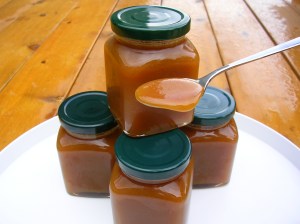
I wanted to make dulce de leche. When looking for a recipe I found a booklet entitled, “Uses of Whey in the Farmstead Setting” (love that title!) from the Wisconsin Department of Agriculture. It includes some bizarre ideas such as whey wine, whey beer and whey champagne. Whey, so I learned, can also be used as animal fodder. The booklet only mentions cattle, pigs, sheep and poultry, but when I fed our dog his pills with the curds I had strained from the whey, he slurped it up in seconds.
Using whey and sugar in a ratio 1:2 as the recipe said seemed outrageous. I decided to tinker with it and cook down the whey first to get it more concentrated, then mixed whey and sugar in a ratio 2:1 (that is one-quart of the suggested amount of sugar!) It worked – the result is a dulce de leche as sweet as it should be, but no more.
Now that I have recycled all the whey, the next question is: what in the world will the farmstead do will all that dulce de leche?
Dulce de leche
1 gallon strained whey
7 cups sugar, depending on the amount of reduced whey
1. Simmer the whey in a large, heavy pot, uncovered, for about 2 hours, stirring occasionally. It will curd a bit but don’t worry, the curds will disappear once the mix, after adding sugar, turns a caramel color.
2. Measure the liquid (I had 14 cups) and add half of that amount in sugar. Slowly bring to a simmer again and cook, uncovered, for 4 to 6 hours, or until the color turns caramel and the mixture thickens. Increase the frequency of stirring as the color darkens, and make sure to scrape over the bottom of the pot.
3. Towards the end, watch the cooking process more closely to prevent the mix from turning too dark. Keep in mind that it will solidify as it cools. Just like for jam and jelly, spoon a bit on a plate and see if it is still too runny. The more solid you want the end result, the longer it needs to cook.
4. Let cool slightly in the pot, then fill into sterilized jars. Only screw the lids onto the jars after the content is completely cooled to avoid condensation build-up. Store in the refrigerator for up to 1 month or freeze in plastic containers.
Makes 5 13-ounce jars
 Green Card Gardener