Overcoming the green tomato prejudice

Until now I have been heavily prejudiced against green tomatoes. Not that I ever ate a green tomato. When I occasionally had green tomatoes in the garden because a branch broke off, or I ended up with green tomatoes at the end of the season, I would rather throw them on the compost pile than using them for cooking.

Maybe it’s the idea of eating something unripe that put me off. I know fried green tomatoes are a southern specialty but I was never tempted to try them. I am not a health fanatic but when I use artery-clogging ingredients, I prefer do to it when there is no alternative, such as butter in a piecrust. Also, I do not like the idea of buying additional produce in the height of the harvest to make something with green tomatoes.

When I collected a couple of pounds of green tomatoes from the garden this week, I reconsidered. I constantly try new things, so why not give green tomatoes a second chance and make chutney? I browsed recipes online and went through my cookbooks for inspiration. The only condition I set for myself was that I would minimize the purchase of extra ingredients. Since I have jalapeno peppers in the garden right now (also a premiere), and lots of fresh garlic, the only thing I had to buy for this Green Tomato Chutney were apples. All the other ingredients were staples I had in the house.

As the prospective main chutney eater besides me does not like it too spicy, I removed the seeds from the jalapenos. I am glad I did because the chutney is already quite hot as is. For a hotter version, simply include some or all of the seeds.

I don’t think I will ever actually pick green tomatoes but at least I have a simple recipe that I like in case green tomatoes come upon me. I look forward to opening the first jar of chutney and eat it with Indian food this fall or winter.

For now it’s back to fresh red tomatoes.

Green Tomato Chutney

2 to 2¼ pounds green tomatoes

10 garlic cloves

1 large onion

1 large or 2 small tart apples (I used green summer apples)

3 jalapeno peppers

1 1-inch piece fresh ginger

1 tablespoon black peppercorns

1 tablespoon whole allspice

6 cardamom pods

1 pound 6 ounces Turbinado sugar

1 tablespoon salt

1 cup white wine vinegar

3 bay leaves

1 tablespoon yellow mustard seeds

6 whole cloves

1 teaspoon dried orange peel

1 teaspoon finely grated zest from an organic lemon

You also need:

A canning pot, or a very large stockpot

5 half-pint canning jars

5 bands

5 new (unused) lids

1. Remove the core from the tomatoes and cut them into 1-inch dice. Slice the garlic cloves thinly. Chop the onion. Peel the apples and remove the core. Cut the apples into 1-inch dice. Cut the jalapenos in half and remove the seeds. Chop the jalapenos very finely. Wear disposable gloves to do this, or wash hands thoroughly afterwards to avoid skin and eye irritation. Peel and finely chop the ginger.

2. Crush the peppercorns, allspice and cardamom in a mortar.

3. Mix all ingredients in a non-corrosive pot (no aluminum) and mix well. Cover and refrigerate for 8 hours.

4. Slowly bring the mix to a boil. Cook uncovered for 20 minutes. Fill into sterilized canning jars using a slotted spoon, as you don’t want to fill the jars with too much liquid but make sure the chutney is fully immersed. You will have about 1 to 2 cups of cooking liquid left over; discard. Close jars with brand new lids and bands immediately and process in boiling water bath for 10 minutes.

5. Remove from the water onto damp kitchen towels. Let rest 24 hours before storing the jars in a cool place away from the light.

Makes 5 half-pint jars

Cantaloupe regale

When I first started growing Charentais French breakfast melons from seed I was so hooked that I vowed I would never grow any other cantaloupe again. But a meager harvest last year, and late start due to a cold spring this year made me reconsider. So I bought four cantaloupe seedlings in May, a variety that came with a high recommendation from the nursery owner. Because I treated them rather as a backup, and not like the real thing, I did not even write down what I bought, which I now regret.

I do not regret growing them. For the past ten days my family has been feasting on large, sweet cantaloupes. I also set some super-ripe ones aside to make a few batches of my Cantaloupe Sorbet, yet this time I used lemon verbena instead of lemon balm, which I think is a step up.

The Charentais are just starting to ripen. By the time they are ready to harvest we will have had our fill so we will be quite happy with having a few breakfast-size melons to nibble on.

Oy whey

Last week it was apricots, this week it’s yellow plums that are at their peak at the local orchard. Fruits and veggies don’t care about editorial diversity. Soon I shall be writing about homegrown tomatoes twice in a row.

I bought The Essential New York Times cookbook a couple of weeks ago and I know it will be my main reading for the rest of the summer. As for cooking from it, I wanted to begin with something really easy so I made ricotta – for the first time. It was easy, though I am not sure I will make it again, for two reasons.

When it was all over, I had almost a gallon of whey left over. Being the thrifty cook that I am, I could not possibly just dump it down the drain. So I froze it in 3-cup batches, enough to bake 10 loaves of bread. I only bake bread about every ten days, so I quickly realized I would soon have nothing in the freezer chest but whey. Also, I must have drained the ricotta for a bit too long, although I did not squeeze it as the recipe instructed.

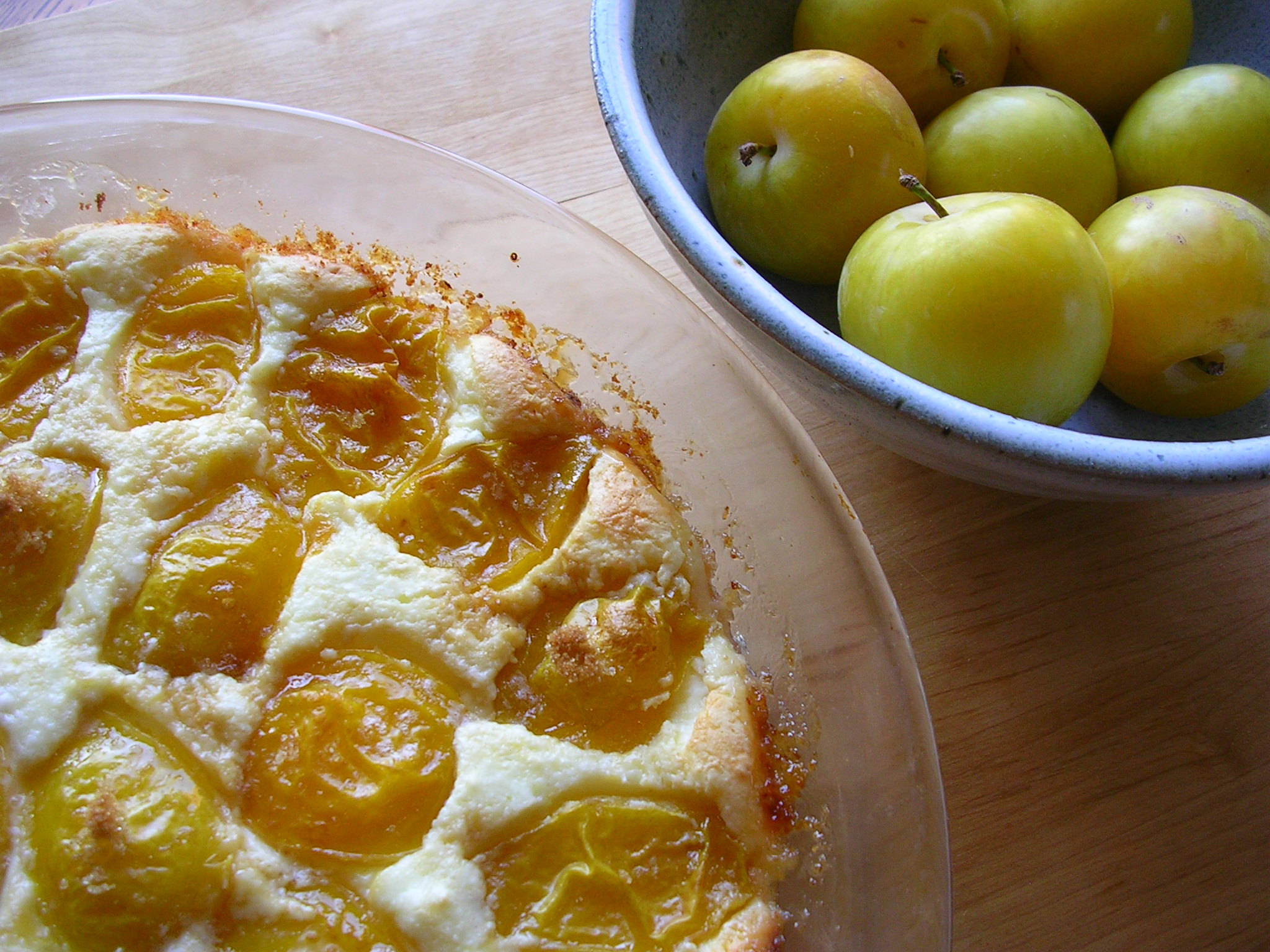
To use up the ricotta, I remembered the Ricotta Cheese Pie from The Joy of Cooking as very good. I took my cues from that filling, but modified it to a crustless pie. Because the yellow plums were so juicy, it did not matter that the ricotta was a bit on the dry side.

Whether I make ricotta again or not, and whether you call this baked custard or crustless pie, I got myself a new recipe for a quick and light summer dessert.

Crustless Ricotta Pie with Yellow Plums

1 tablespoon butter + more for the pan

Breadcrumbs

1 pound well-drained ricotta

2 eggs

2 teaspoons finely grated lemon zest

2/3 cup sugar

Light brown sugar

8 ripe yellow plums

1. Preheat the oven to 375 degrees F.

2. Butter the bottom and sides a 9-inch pie pan and sprinkle with breadcrumbs. Turn it upside down over the sink and knock off any excess crumbs.

3. Beat the ricotta, eggs, lemon zest and sugar with an electric mixer until well combined.

4 Pour it into the prepared pan and spread evenly with a spatula.

5. Halve the plums and remove the pits (this usually works best when twisting them slightly but sometimes the pit clings. In that case remove the pit with a small paring knife.

6. Arrange the plum quarters in circles on the filling. Dot with butter and sprinkle with brown sugar.

7. Bake 30 to 40 minutes in the preheated oven, or until the pie is set but still a bit wobbly, and lightly browned on top. Serve lukewarm or cold.

Apricot tart, juicy and impromptu

My baking is often quite unorthodox. I start with a recipe, then change course mid-way, hoping it will work out. This time I had a basket full of beautiful, super-ripe apricots from a local orchard sitting on the counter. The apricots were so juicy that I feared the crust would turn soggy if I placed the apricots directly on the dough. So I turned the recipe upside down. I sprinkled the dough with the sugar-almond mix that was supposed to go on top, and made another batch of the almond-sugar mix for the topping. In fact the apricots were so juicy that as an additional precaution, I placed a jelly roll pan on the rack underneath to catch any drippings, and I am glad I did.

I took notes just in case the apricot tart would turn out fine. It did! Here is the recipe:

Apricot Tart:

Crust:

1 1/3 cups flour

1 stick chilled unsalted butter, cut into chunks

1/3 cup + 1 tablespoon sugar

Pinch of salt

1 egg yolk

Topping:

1/3 cup whole unpeeled almonds

1/3 cup sugar

4 tablespoons apricot preserves

1.5 pound ripe apricots

1. Place the flour and the butter in the food processor and process to a crumbly consistency. Add the sugar, salt and egg yolk and process until the dough forms a ball. Put the dough in a container with a lid or in plastic wrap and place in the freezer for 20 minutes.

2. Toast the almonds in an ungreased pan. Cool, then grind in the food processor with 1/3 cup sugar.

3. Butter a 9-inch tart pan (I used one with a removable bottom) and sprinkle with 1 tablespoon of the almond mix.

4. Preheat the oven to 400 degrees F.

5. Roll out the dough between two pieces of wax paper to a 11-inch circle. Fit the dough into the tart pan with the dough coming up the sides. Trim extra dough with a knife or gently even it out by pinching it together with your fingertips. Sprinkle with half of the remaining almond mix.

6. Wash the apricots and dry well. Cut in half and remove the pits. Place the apricots on the dough cut-side down; they should fit snugly.

7. Warm the apricot preserves and strain them through a fine sieve and brush the apricots with it. Sprinkle with the remaining almond mix and bake in the preheated oven for 40 minutes, or until the crust is golden. Let cool on a wire rack.