Late bloomer

The best I could do which chive blossoms in the past, was stick them in a vase. I am an admitted late bloomer when it comes to learning about edible flowers. This year I am at last discovering all the wonderful things you can do with them. I wish I had more chive blossoms right now.

The first bloom of the chives yielded just enough blossoms to make a tiny amount of chive vinegar. I absolutely do not like the taste, smell and especially aftertaste of raw onions. Letting a chopped shallot sit in vinaigrette for a mere hint of onion flavor, and strain it afterwards is my tolerance limit for raw onions. So I thought chive vinegar would be a good way to get the onion flavor without the onions.

Asparagus is one of the crops I do not grow in my garden because I can buy it super fresh from local farm stands. The asparagus was supposed to be for dinner tonight. Yet before I had even washed the dishes my husband and I had nibbled most of it for lunch before heading back to our offices.

No doubt, I will have to plant more chives for the blossoms alone, so I can make more of that vinegar.

Asparagus with Sauce Tartare

The formula for the vinegar is simple: Put freshly picked untreated chive blossoms, washed and drained, in a screw-top jar. Add apple cider vinegar, enough to immerse the blossoms. Cover and let sit at moderate room temperature, away from direct sunlight, for 5 to 7 days until the blossoms are completely discolored. Shake the jar once or twice a day. Strain and discard blossoms.

The Sauce Tartare is adapted from Julia Child’s Mastering the Art of French Cooking.

1 pound green asparagus

1 tablespoon lemon juice

Sauce Tartare:

3 large hard-boiled eggs

1 tablespoon Dijon mustard

¼ teaspoon salt, more to taste

2/3 cup olive oil

1 tablespoon chive vinegar

2 tablespoons capers, drained

3 tablespoons finely chopped chives

Freshly milled black pepper

1. Wash the asparagus and trim the ends.

2. Bring water to a boil in a large deep skillet. Add the lemon juice and cook the asparagus uncovered at low to medium heat until it can be pierced with a kitchen knife. Drain, rinse with cold water, and drain again. Set aside.

3. For the Sauce Tartare, separate the yolks from the eggs, leaving the whites as intact as possible. Finely chop the egg whites and set aside. Mash the yolks with the mustard and the salt until no lumps remain.

4. Gradually add the olive oil and whisk thoroughly by hand until you obtain a thick smooth emulsion. Add the vinegar and whisk until fully incorporated.

5. Finely chop the capers and add them to the sauce with the chives. Season with salt and pepper. Spoon some of the sauce over the asparagus, and sprinkle with chopped egg whites.

Makes 2 servings

Trust your recipes

There is so much gardening to do I had no intention to blog this weekend. But after my cookie mishap this morning (which turned out fine), I cannot help but ranting a bit here.

I woke up early and since it was too chilly to go outside, I decided to try out some cookies with the wonderful Meyer lemon scented olive oil I bought a few days ago. I found a Youtube recipe video that sounded perfect. I did not watch the video but followed the written recipe, modifying it a bit in terms of flavorings but making sure to stick with the ratio of dry and liquid ingredients.

The dough was supposed to be rolled out and cut into desired shapes. There was no way that sticky dough was suitable to be rolled out so I put away my cookie cutters and dropped spoonfuls of the dough onto the baking sheet. The result was rather biscuits than cookies but they tasted good. For the next batch, I used a pastry bag and ended up with perfectly round little cookies.

While the cookies were in the oven, I reread the recipe several times, wondering what mistake I had made. I had made none. Only then did I watch the video. The dough looks as sticky as mine, but then a heap of flour is added during the kneading. I cannot imagine those cookies will taste so nicely light as mine if you add so much flour for kneading. And, at best, the dough could be cut into plain circles, but “desired shapes”? I don’t believe it. The original recipe clearly did not work, at least not for me.

Whether you are an experienced cook or a beginner, it is always a frustrating experience when a recipe does not work, and usually you assume that you did something wrong. But the sad fact is that there are lots of flawed recipes out there, some of them with plain errors, others leaving too much up to luck. I don’t want to sound judgmental, I acknowledge that recipe-writing is not an easy thing. The devil is in the details and there is plenty of room for errors. Of course I’ve made them, too.

No more kvetching! After all I ended up with wonderfully light, lemon-scented cookies that I will surely bake again. But I won’t make a video out of it. Promised.

Lemon Olive Oil Cookies

I used ground steamed poppy seeds that I brought back from Germany. In the US you can find ground poppy seeds (and I do not mean the sticky, gooey poppy seed cake filling) in specialty spice stores, or you can grind your own. If you cannot get your hands on ground poppy seeds, just leave them out. They are a nice addition but not essential to the recipe.

1 organic lemon

½ cup Meyer lemon extra-virgin olive oil

½ cup non-fat Greek yogurt

½ cup low-fat plain yogurt

1 large egg

1 teaspoon vanilla extract

½ cup plus 3 tablespoons sugar

2¾ cups flour

1 teaspoon baking soda

¼ teaspoon salt

3 tablespoons ground poppy seeds (optional)

1. Preheat the oven to 375 degrees F. Line a large baking sheet with parchment paper or with a baking mat.

2. Zest the lemon and set aside 1 teaspoon. Refrigerate or freeze the rest of the zest for another use. Squeeze the lemon and set the juice aside.

3. Mix the olive oil, both yogurts, egg and vanilla extract in a bowl with an electric mixer. Add ½ cup sugar.

4. Put the remaining 3 tablespoons sugar in a food process with the lemon zest and process until the sugar is fragrant and slightly yellow. Add this the olive oil mix.

5. In another bowl, mix the flour with the baking soda, salt and poppy seeds, if using. Add to the olive oil mix and beat until fluffy.

6. Fill about one-third of the dough in a pastry bag with a plain round tip and squeeze small rounds, about 1.5 inch, onto the baking sheet, leaving ample space between them.

7. Bake in the middle rack of the preheated oven for 12 minutes, until the cookies are lightly yellow and set. Proceed the same way with the rest of the dough, which will make 2 more cookie sheets.

8. Cool the cookies on wire racks and store in airtight tins.

Makes 100 cookies

Turning scent into flavor, or: lilac for dessert

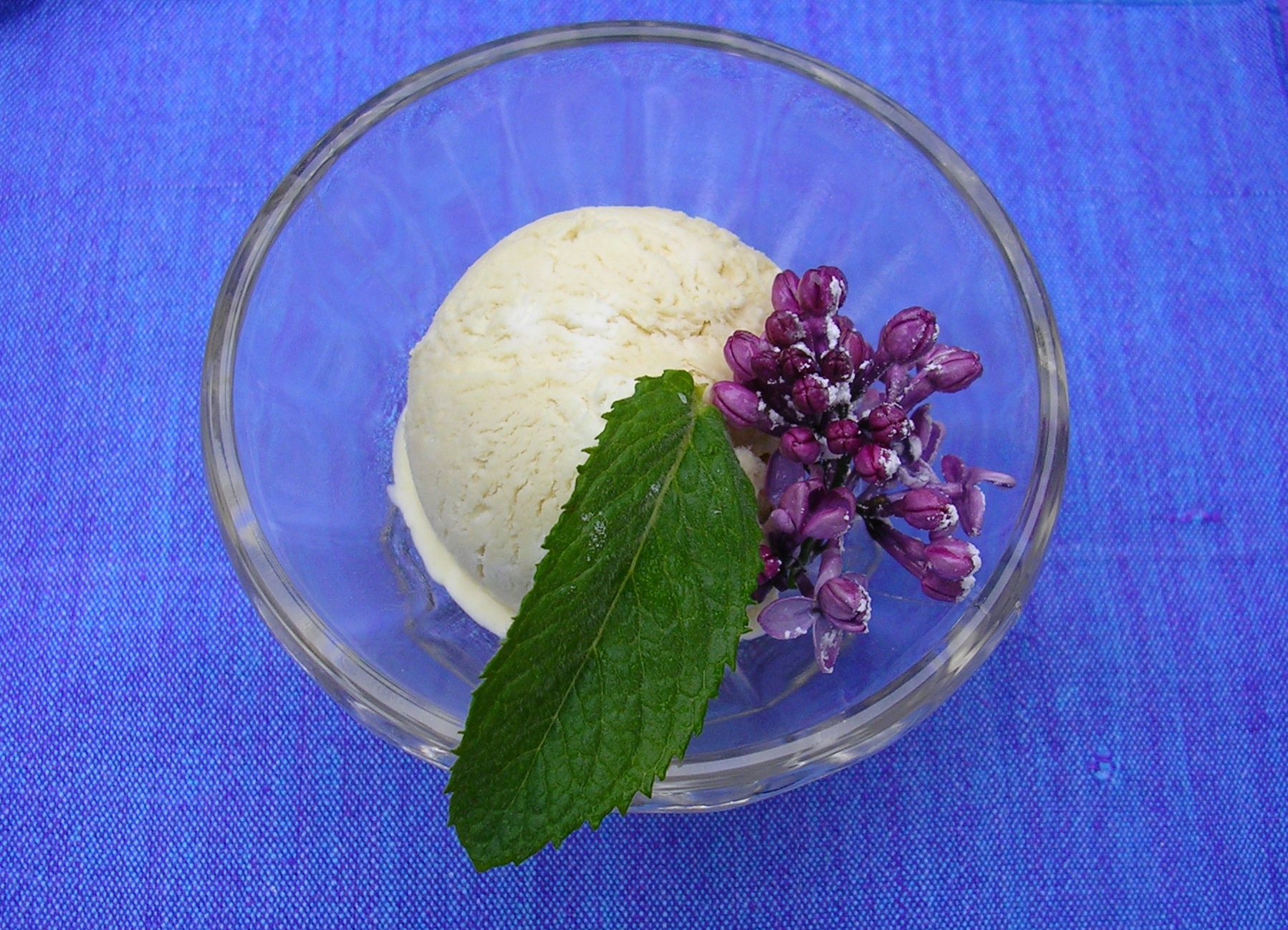
Lilac parfait
Lilacs, I was told a few years ago in gardening class, have so little wildlife value they might as well be made of plastic. Since I love lilacs, especially the Dwarf Korean lilac with its knockout scent, this was bad news. Ever since, I have eyed the lilacs around our house with a mix of doubt – whenever I spot bees swarming around a lilac bush, I am telling myself it cannot be that bad – and a bit of guilt, because every year I transplant lilac shoots and rejoice about them taking off so easily and growing fast with so little maintenance.

To put my scruples to rest, I am telling myself that we encourage a lot of wildlife on our property by providing shelter, food and a pesticide-free and insecticide-free environment. So the dozen or so lilac bushes really don’t matter.

Earlier this week, my favorite magazine arrived in the mail from Germany: Landlust, a stunningly beautiful yet very hands-on magazine about rural living, which The Economist described very aptly in a June 2011 article as the Germans’ “nostalgie de la boue”.

The latest issue had a recipe for lilac-infused ice-cream in it. I had no idea lilac blossoms were edible. After a bit of poking around on the Internet to make sure that lilac blossoms are indeed edible (not that I don’t trust the magazine editors) I decided to concoct my own recipe, a modification of the Honey Parfait from my cookbook Spoonfuls of Germany. I felt the airy consistency of parfait, which is made without an ice-cream maker, is a better match for the ethereal lilac aroma than a heavy, custard-based ice cream.

Now that I am on an edible flower roll, lilac syrup is next. The blossoms are steeping as I write this. It should be ready in about five days.


Lilac Honey Parfait

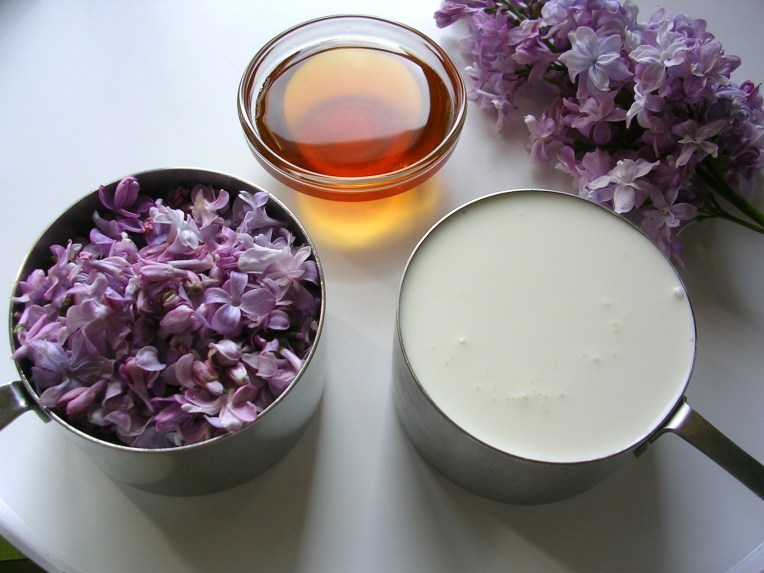
1 cup freshly picked lilac blossoms

1 cup heavy cream

3 large, very fresh eggs, separated

½ cup golden honey

Pinch of salt

Lilac parfait ingredients
1. Wash the lilac blossoms in cold water to remove any dust and insects. Drain in a colander and shake to remove excess water. Spread on a piece of paper towel, gather the edges and gently shake to dry even more. Place blossoms in a small bowl. Pour the heavy cream over the blossoms and push them down so they are fully immersed in the cream. Cover with plastic foil and refrigerate for 24 hours.

2. Strain the cream through a fine sieve. Push down the blossoms so extract as much cream from the blossoms as possible. Set the blossoms aside. Whip until if forms soft peaks. Refrigerate.

3. Beat the eggs whites with a pinch of salt until stiff. Refrigerate.

4. Put the egg yolks and the honey in a double boiler or a metal bowl place over a pot of gently boiling water. Whisk until the mix becomes thick and very foamy. At the end, add the blossoms and stir for another 1 to 2 minutes. Strain through the sieve and again squeeze down on the blossoms until no more liquid comes out.

5. Place the bowl over a bowl of ice water and continue stirring until cooled.

6. Fold the cream and the egg whites into the egg yolk mix. Pour the parfait in a pre-chilled container and freeze for at least 4 hours, or until firm.

Makes 6 servings

All the whey

Compared to one-third of all food that is being wasted worldwide, cringing over throwing out a heel of home-baked bread because it turned moldy might seem puny. Yet I found myself thinking of ways how I can prevent this from happening again. Yes, I am sort of a relentless food saver. Therefore I of course had to do something with the gallon of whey that I brought back from the instructional and fun mozzarella-making potluck at phoebe’s pure food last weekend.

I wanted to make dulce de leche. When looking for a recipe I found a booklet entitled, “Uses of Whey in the Farmstead Setting” (love that title!) from the Wisconsin Department of Agriculture. It includes some bizarre ideas such as whey wine, whey beer and whey champagne. Whey, so I learned, can also be used as animal fodder. The booklet only mentions cattle, pigs, sheep and poultry, but when I fed our dog his pills with the curds I had strained from the whey, he slurped it up in seconds.

Using whey and sugar in a ratio 1:2 as the recipe said seemed outrageous. I decided to tinker with it and cook down the whey first to get it more concentrated, then mixed whey and sugar in a ratio 2:1 (that is one-quart of the suggested amount of sugar!) It worked – the result is a dulce de leche as sweet as it should be, but no more.

Now that I have recycled all the whey, the next question is: what in the world will the farmstead do will all that dulce de leche?

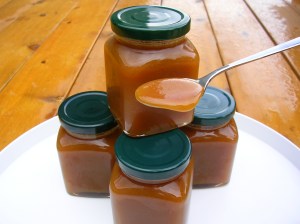
Dulce de leche

1 gallon strained whey

7 cups sugar, depending on the amount of reduced whey

1. Simmer the whey in a large, heavy pot, uncovered, for about 2 hours, stirring occasionally. It will curd a bit but don’t worry, the curds will disappear once the mix, after adding sugar, turns a caramel color.

2. Measure the liquid (I had 14 cups) and add half of that amount in sugar. Slowly bring to a simmer again and cook, uncovered, for 4 to 6 hours, or until the color turns caramel and the mixture thickens. Increase the frequency of stirring as the color darkens, and make sure to scrape over the bottom of the pot.

3. Towards the end, watch the cooking process more closely to prevent the mix from turning too dark. Keep in mind that it will solidify as it cools. Just like for jam and jelly, spoon a bit on a plate and see if it is still too runny. The more solid you want the end result, the longer it needs to cook.

4. Let cool slightly in the pot, then fill into sterilized jars. Only screw the lids onto the jars after the content is completely cooled to avoid condensation build-up. Store in the refrigerator for up to 1 month or freeze in plastic containers.

Makes 5 13-ounce jars