Beans in a brick

Unlike chicken under a brick, beans in a brick is not a recipe but the way I grow green beans. Every year I had entire rows of French filet beans, aka haricots verts, getting knocked over, a paining sight. Whether it’s the wind on our hilltop, or the weight of the beans that does it, I don’t know.

I tried different things, from securing every plant individually with a small stake (tedious and useless) to stretching wire along each side of the row (equally useless). I even called the company where I bought the seeds to find out what they recommend but they did not seem to understand what I was talking about, since the beans are described as self-supporting in the catalog.

Then, one day, I was standing outside the car wash waiting when my eyes fell on a pile of bricks nearby. What if I buried the seeds into the holes of bricks and let the plants grow into them? That way the crucial first 1.5 inches of the stem, where the plants always break, would be protected. Lucky coincidence – our local hardware store was just discontinuing selling bricks, so I got a few dozen bricks for free.

It worked! I seed the beans very densely, one in every hole, so they also support each other. The most important thing is not to move the bricks the slightest bit after seeding because the small hole is the seed’s lifeline to air and light. Without it, no germination!

A few plants still get knocked over, but this is minimal compared to the previous damage. Now it’s almost time to harvest, and I am looking forward to my favorite salad with green beans. The original recipe is from Bon Appetit but because I don’t like raw onions of any kind, I omit the shallots in the dressing. Since with my growing method, I get a good crop of haricot verts, I use three times more green beans than the recipe calls for. Therefore this is not a Potato Salad with Haricots Verts, but a Haricot Verts Salad with Potatoes.

Haricot Verts Salad with Potatoes, Blue Cheese and Walnuts

1 tablespoon + 1 teaspoon Dijon mustard

1 tablespoon white wine vinegar

1/4 cup extra-virgin olive oil

2 teaspoons chopped fresh rosemary

3/4 teaspoon chopped fresh sage

1 pound small reds-skinned potatoes

Salt

1.5 pounds French filet beans

1/3 cup walnuts

2/3 cup crumbled  blue cheese (Gorgonzola or Roquefort)

Freshly ground black pepper

1. Preheat the oven to 450 degrees F.

2. Whisk the mustard with the vinegar and olive oil. Stir in the rosemary and sage.

3. Wash the potatoes and toss them whole with 3 tablespoons vinaigrette until they are evenly coated. Spread them in one layer in a baking dish. Bake in the preheated oven for 20 minutes. Reduce the heat to 375 degrees F and bake for another 40 to 50 minutes until they are soft, turning them once in a while. Cool.

4. Bring salted water to the boil in a large pot. Have a large bowl with ice water standing by. Cook the beans in the boiling water for 3 minutes. Drain and throw immerse the beans in the ice water immediately. Swirl them around so they cool evenly. Drain again.

5. Lightly toast the walnuts in an ungreased pan. Chop them coarsely.

6. In a large bowl, mix the potatoes, green beans, cheese, walnuts and the remaining vinaigrette.  Season with salt and pepper.

Makes 6 servings

Eyes bigger than the basket

Blueberries
Yesterday I went blueberry picking at a berry farm. It was drizzling on and off and therefore empty and very quiet. I picked and picked until my basket was full – slightly over 27 pounds!
Most of it went into the freezer for pies, cakes, crumbles, and smoothies. It makes up for my own meager harvest of black currants and gooseberries, which I blame partly on my negligent pruning last year, and partly to the chipmunks.

While I love blueberries I don’t care much for them in their raw state. Chilled blueberry soup, a specialty from northern Germany, is a favorite of mine and perfect on hot summer days. The recipe can be found in my cookbook Spoonfuls of Germany.

Blueberry Soup

Field to Fork

I started this blog a year ago. Every minute of writing, photographing (and eating) has been enjoyable. I think I am even a more passionate gardener today than I was a year ago. For me, growing your own food is one of the most fulfilling things you can do, and I wish more people with a backyard would do it. That’s why I am so enthusiastic about “Field to Fork”, the event that the Master Gardeners in Schuylkill County, of which I am a member, will hold on August 20th. It’s a show-and-tell-and- taste, where containers with a variety of homegrown fruits and vegetables will be on display, and samples of different dishes for the public to taste.

The whole thing began last summer after I bought of a copy of Jim Denevan’s cookbook Outstanding in the Field. Denevan is a chef and artist from California who tours the United States every year, holds dinners at places where organic food is grown: farms, vineyards, wineries, ranches etc.

I went online and saw that a dinner in our area was scheduled for September. Too bad it’s sold out, I told my husband, and started doing other things in the kitchen. He grabbed the laptop and asked, “Do you have any idea how much it costs?” I didn’t. 200 dollars per person plus tax plus service fee. Even if I could, I would never spend that amount of money for a meal. As beautiful as it is, the long tables in a rural setting – and from the recipes in the book I know the food must be delicious –  the socialist in me revolted. Events like this cater to a food elite that is already conscious of healthy eating.

Then I started thinking. We need something very low key, very affordable, very grass-root for this area. Although this is farm country, only a fraction of people, many of them with large properties, have their own food gardens. In the cities, on the other hand, the waiting lists for a plot in a community garden are long, and often even closed for new applicants.  Is there a better way to inspire someone to grow fruits and veggies than to show them the plants you grow, put some tasty homemade food in their mouth, and say “You can do this, too!”.

Before I joined the Master Gardeners, this absence of making use of the land on which we sit plainly angered and frustrated me. Now, by joining forces with other like-minded gardeners, I feel we can do something about it. If only a handful of people are inspired to grow their own food, “Field to Fork” will have fulfilled its purpose.

“Field to Fork” will be held at Frisbee Farm in Orwigsburg, PA, on August 20. For more information click here.

Nosh for gardeners

We are notoriously late eaters. Especially in the summer, when my husband and I use every minute of sunlight to work outside, we do not sit down for dinner before 8:30 or 9:00 o’clock.  People around here eat as early as 5 and certainly not later than 6 o’clock.

Last week, when my son’s friend stayed for dinner, I asked him jokingly how he puts up with our moonlight dinners. He told me that he usually has dinner at home before coming here. This could be either a compliment for my cooking, or simply the fact that 19-year-old boys are always hungry. I won’t speculate.

For my part, I am usually famished by the time I have dinner on the table because I often don’t eat much during the day. Yes, I know, that’s an unhealthy habit. However, when I know there is something appealing in the fridge, I find it easier to pull myself away from gardening to have a bite.

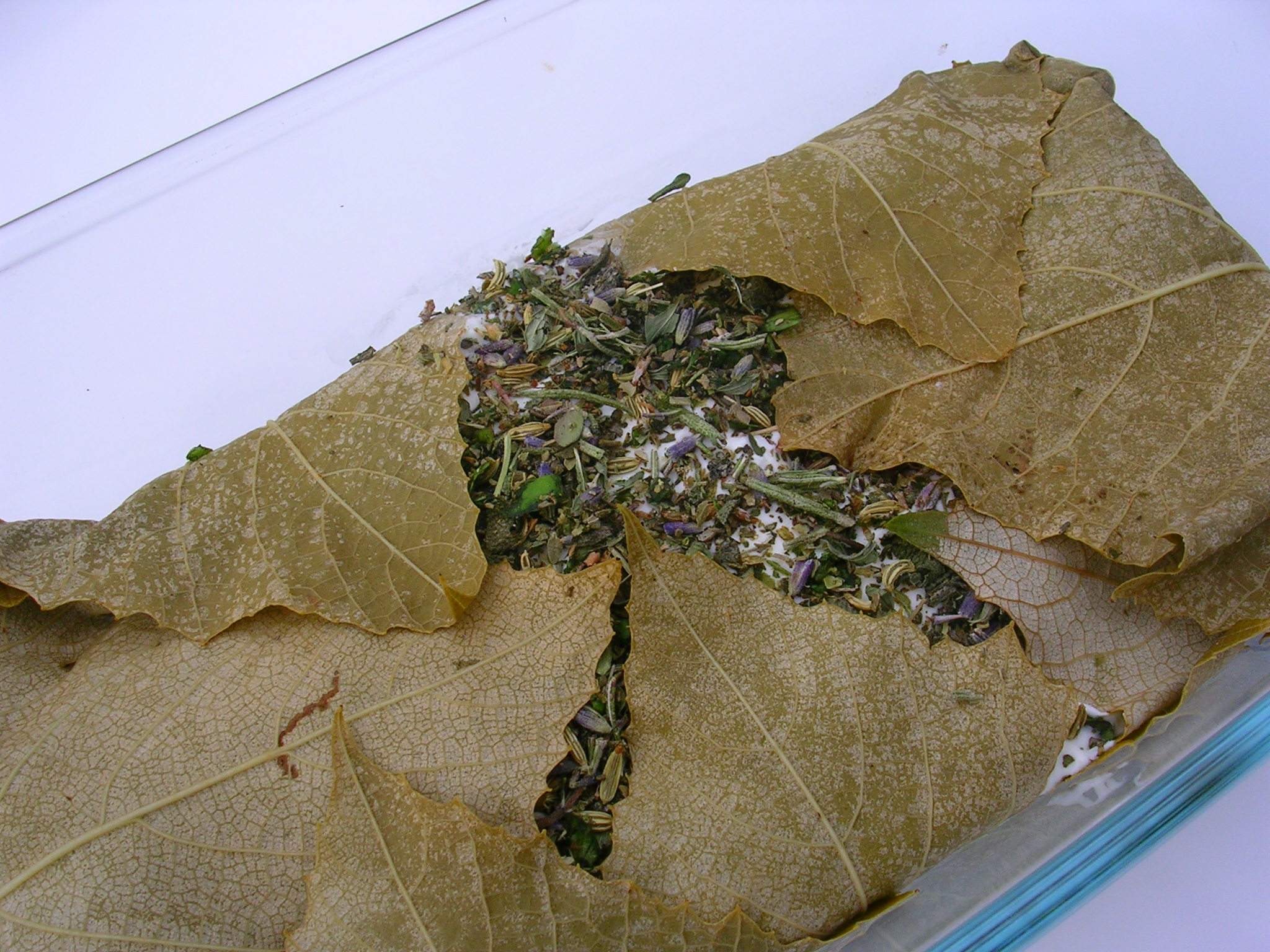
I had the idea for a terrine like this for a while but I had to wait for the leaves on my two concord grapes to grow big enough. I mix the herbes de Provences from equal amounts of dried basil, sage, rosemary, summer savory, thyme, marjoram, fennel seeds, oregano and lavender.

Over-estimating the volume of the goat cheese, I used a 1.5-quart glass loaf pan, in which the terrine looked a bit lost. A smaller loaf pan or a rectangular glass storage container would have worked better. Next time…

Goat Cheese Terrine

6-8 large organic grape leaves

1 fresh goat cheese (10.5 ounces)

2 tablespoons heavy cream

1 garlic clove, finely chopped

3 tablespoons finely chopped sundried tomatoes in oil, drained

3 tablespoons pitted Kalamata olives, finely chopped

3 tablespoons herbes de Provence

1. Wash the grape leaves and place them in a heatproof bowl. Pour boiling water over them to cover. Let stand for 4 minutes, then drain and spread on paper towels to dry.

2. Beat the goat cheese and the cream with an electric mixer until smooth. Try not to add more cream, otherwise the cheese will end up too liquid. Mix in the garlic.

3. Line a rectangular small glass dish with the leaves up the sides, so you can fold them over after filling.

4. Spread 1/3 of the cheese on the bottom. Evenly sprinkle with the tomatoes.

5. Spread 1/3 of the cheese and evenly sprinkle with the olives. Spread the remaining cheese on top and sprinkle with the herbs.

6. Fold the leaves over. Cover with plastic wrap and refrigerate for at least 2 hours. To serve, flip the terrine over onto a serving dish or a nice cutting board. A serrated knife works best to cut through the grape leaves.