No eggplant left behind

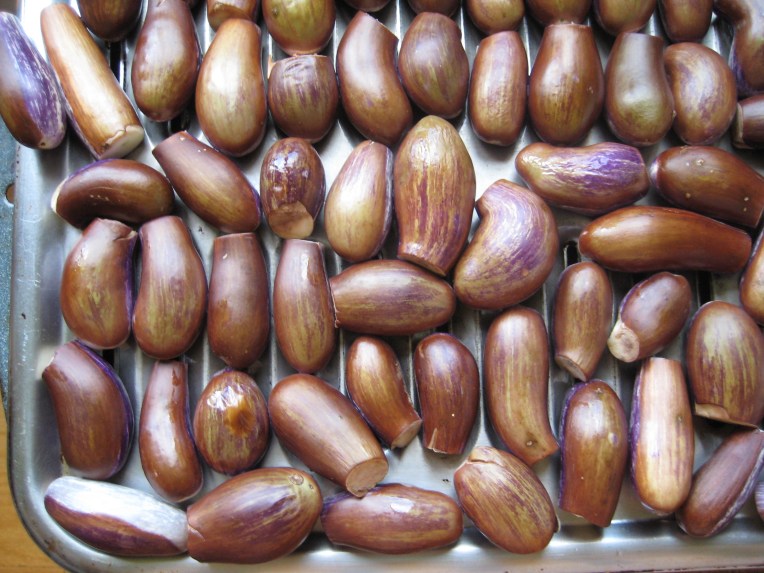
As the nights are getting chilly, the skin of the delicious Fairytale eggplants toughens. A few days ago the eggplants melted in your mouth. Now you can still eat them whole, and they are still good, but they are not at their peak any more.

I picked my six plants clean and used the larger ones for a dip adapted from Deborah Madison’s excellent Roasted Eggplant Dip with Dill, Yogurt, and Walnuts, which I like better than traditional Baba Ghannoush with tahini. As eggplants and eggplant skins are a good addition to vegetable broth (here is my recipe), that’s where all the other tiny eggplants are going.

Not a single eggplant left. I will for sure grow those again next year!
Fairytale Eggplant Dip with Dill

Adapted from Vegetarian Cooking for Everyone by Deborah Madison

There is more waste from all the skins of the small Fairytale eggplants, therefore I started with a full 2 pounds of eggplant instead of the 1 1/4 pounds in the original recipe. Also, I always throw in a handful of dill fronds (all tough thick sprigs removed) instead of chopping the dill, as everything gets finely pureed in the food processor anyway.

2 pounds Fairytale eggplants

Olive oil

1/3 cup walnuts

3 garlic gloves

1 handful of fresh dill fronds

3 tablespoons extra-virgin olive oil, more for pouring onto the dip

1/2 cup Greek yogurt (I used 0%)

Salt

Freshly milled black pepper1. Preheat the oven broiler and set the rack about 5 inches from the heat.

2. Cut the blossom ends off the eggplants. Put the eggplants in a large bowl and toss them with a little olive oil to coat evenly. Distribute them evenly in one layer on a roasting pan and place them under the broiler. Stand by closely, they turn brown very quickly. Once the tops have slightly charred, turn them and broil from the other side. Test one eggplant to check if the skin can be easily removed; if not, let the skins char some more, turning the eggplants as needed. Remove from the oven and cool slightly.

3. As soon as the eggplants are cool enough to handle, remove the skins. The easiest way to do this is by making an incision along the length of each eggplant and flap it open. Collect the pulp in a bowl and set aside to cool.

4. Lightly toast the walnuts in an non-greased pan. Let cool, then place it in the food processor, together with the eggplant pulp and all the other ingredients. Puree to a fine consistency and salt and pepper to taste. Alternatively, you can also puree the dip with a stick blender if the bowl is large enough to hold all the ingredients. Scoop the dip into a container with a tight-fitting lid and pour a little extra-virgin olive oil on top to prevent it from drying out. Refrigerate. Serve at room temperature, stirring well to smoothen before serving. The dip keeps in the refrigerator for 4 to 5 days.
Color, after all

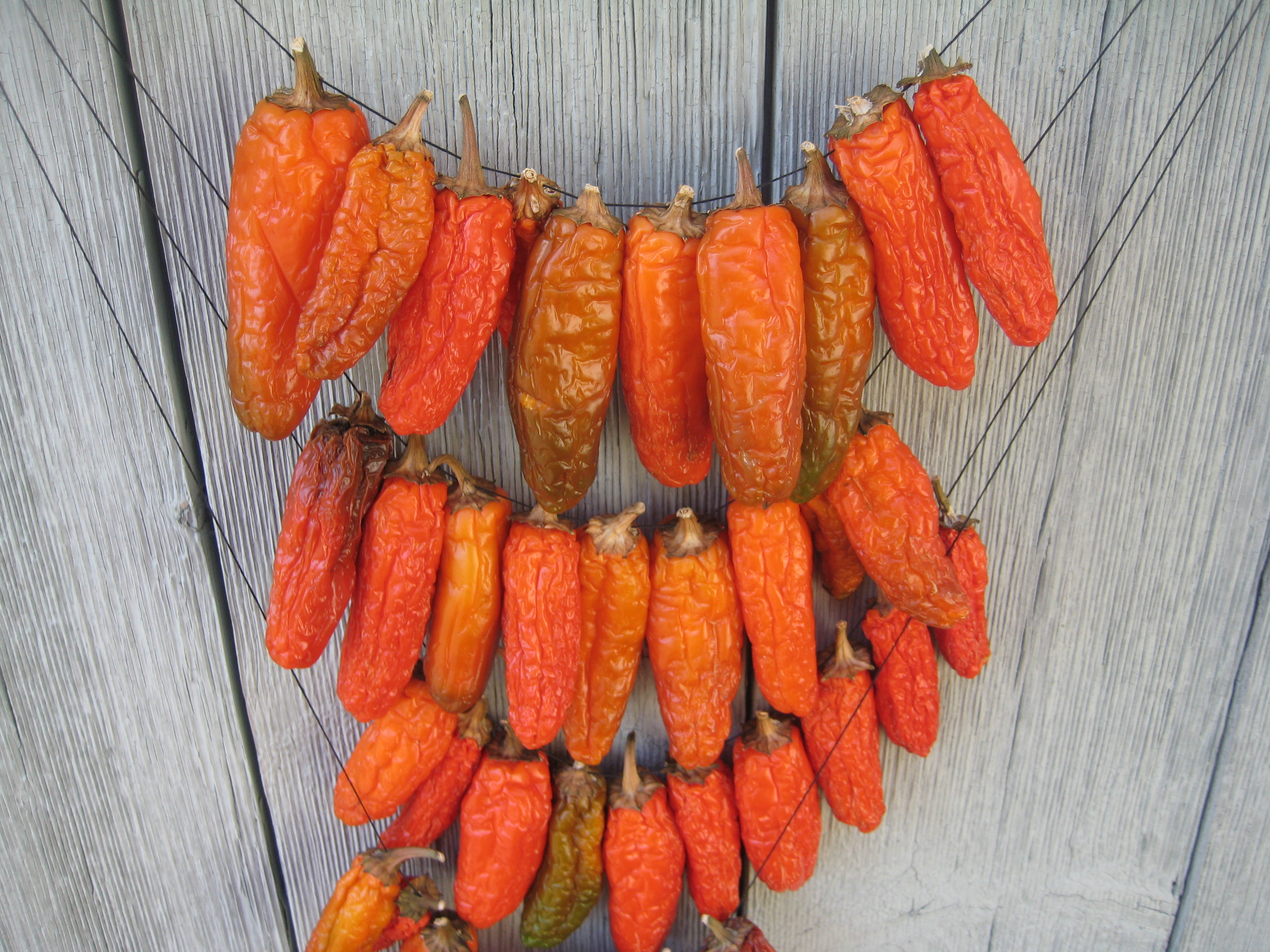
I was too quick concluding that the jalapeños from the garden I hung up for drying are not changing color – they are. On sunny days I put them out every morning, move them with the sun in the afternoon, and bring them in at night. That might sound quite involved but what wouldn’t I do for a good, homemade harissa?

The harissa that comes in small cans like tomato paste or tubes is awful – it is nothing but hot. The real stuff for me is harissa berbère. It is based on sun-dried chilis and blended with garlic and spices. When I lived in Tunis, one of the highlights of my week was shopping at the Marché central on Saturdays. I would always buy a glob of harissa berbère, which was sold in bulk from a large mound sitting out in the open. The spice merchant would scoop off a glob onto a piece of wax paper. I usually could not wait to spread it thickly on fresh flatbread with nigella seeds, another one of my favorites. When I told my aunt that I bought harissa in bulk at the market, she was appalled. I never got sick.

It will be a while before the chili peppers are ready but I already have my harissa recipe lined up. Unfortunately I don’t have my Tunisian grandmother’s recipe. This is as close to hers, and other genuine harissa berbère, as I could get it.

Harissa

Basically you can use any red chili peppers you like. The more seeds you remove, the milder the harissa will be. I usually remove most of the seeds. Wear disposable gloves when handling the chilis. Harissa keeps for several weeks in the fridge.

12 dried red chili peppers

1 tablespoon plus ¼ cup extra-virgin olive oil, more for pouring on top

3 cloves garlic, peeled and finely chopped

½ teaspoon coarsely ground caraway seeds

½ teaspoon coarsely ground cumin

½ teaspoon coarsely ground coriander

Kosher salt to taste

1. Remove the stems from the peppers. Cut them in half and remove all or some of the seeds. Put the peppers in a small heatproof bowl. Pour boiling water over them, just enough to cover. Press the peppers into the water and soak for a few minutes.

2. In the meantime heat 1 tablespoon olive oil in a small skillet. Add the garlic and spices and cook over medium heat until fragrant. Stir often and make sure the garlic does not brown. Remove from the heat and let cool.

3. Drain the chilis and place them in the food processor with all the other ingredients. Process in a food processor or blender to a coarse or fine consistency according to taste. Season with salt and fill in a sterilized glass jar. Smoothen the top and pour additional olive oil over it to prevent harissa from drying out, and refrigerate.

Another sweet reason to garden

In August friends from Germany were visiting. They duly admired the huge red and orange bell peppers in my garden but what they marveled about most were the sweet juicy cantaloupes. In Germany, summers are often so chilly and sun-less that not even the tomatoes turn fully red, let alone crops like melons can be successfully grown.

After many years in the United Stated I had almost forgotten how astounded I was myself seeing a fig tree in the middle of New York City, and realizing that melons that taste and smell like melons are grown locally. Through my friends I appreciated anew our consistently warm to hot summers. Sure, as gardeners we battle against pests, droughts, floods and winter damage, and the recent change of the USDA hardiness zones due to global warming is worrisome. Yet this is a great climate for gardening, and I wish more people would do it.

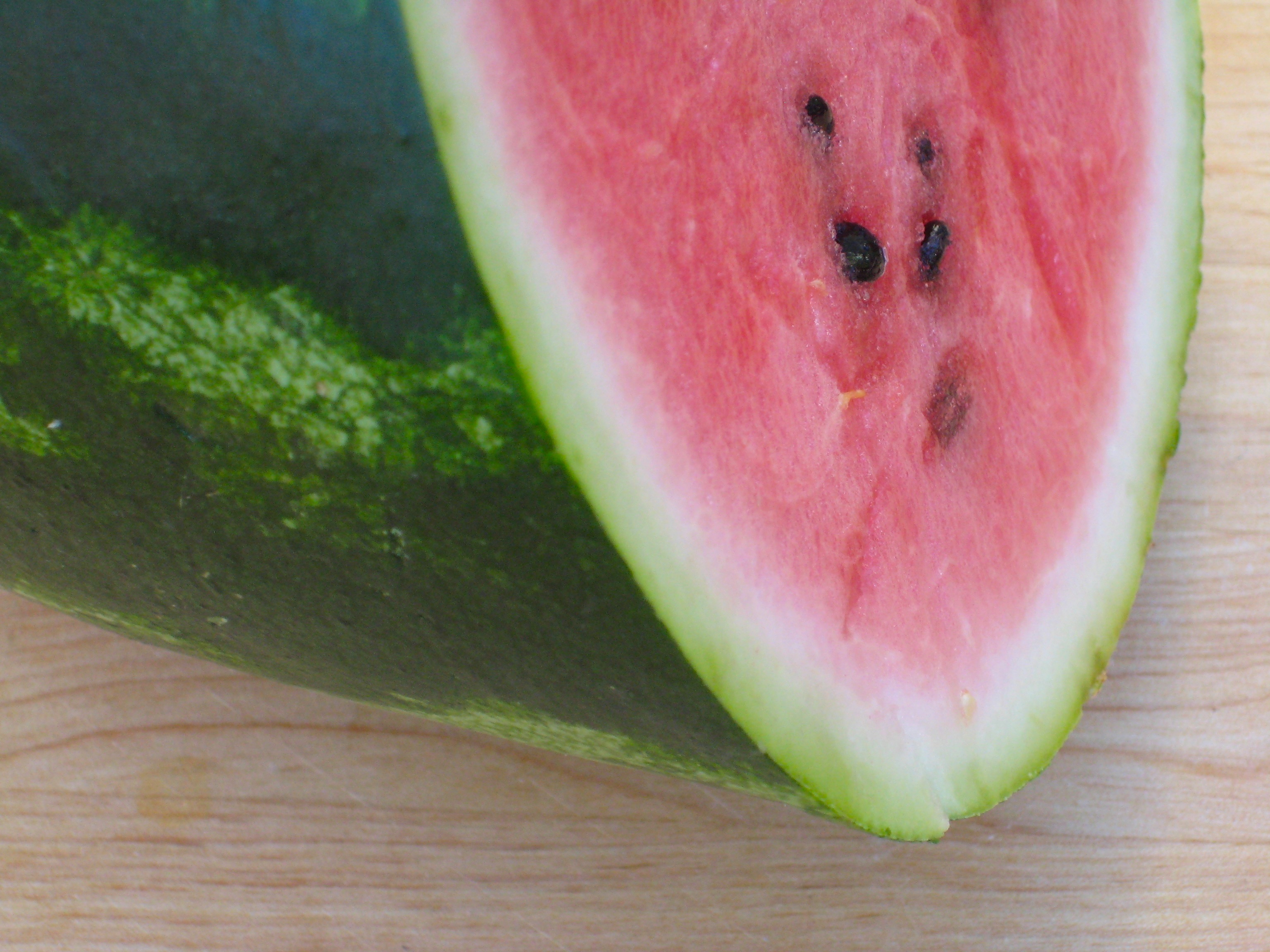
Yesterday I harvested my one and only watermelon. It owes its existence entirely to a feeling of frustration. In early June, I picked up a couple of plants on my third trip to the nursery to replace the cantaloupe seedlings that had been devoured by the striped cucumber beetle.

Small as it is, the watermelon still makes me gleeful.  It is too special for eating the whole thing so I set aside some to make watermelon vodka for the first time. It will be the perfect drink for toasting the garden long after I will have put it to rest for winter.

Concord grape solution

Although I have been terribly neglecting my two Concord grape plants (note to myself: read up on grape pruning this winter), they are quite plentiful. Now I am facing the same question as last year – what should I do with them? The truth is, I don’t care much for raw Concord grapes, nor for grape jelly. I planted the grapes for our daughter who has since flown the nest.

My attempt to make fruit leather last year yielded a sticky mess so I had to come up with a new idea. Schiacciata, the stuffed Italian flatbread is made only during grape harvest, sounded good yet it seemed to be rather sweet. I envisioned something more savory. Also, Concords are so juicy that I was afraid they would make the flatbread soggy.

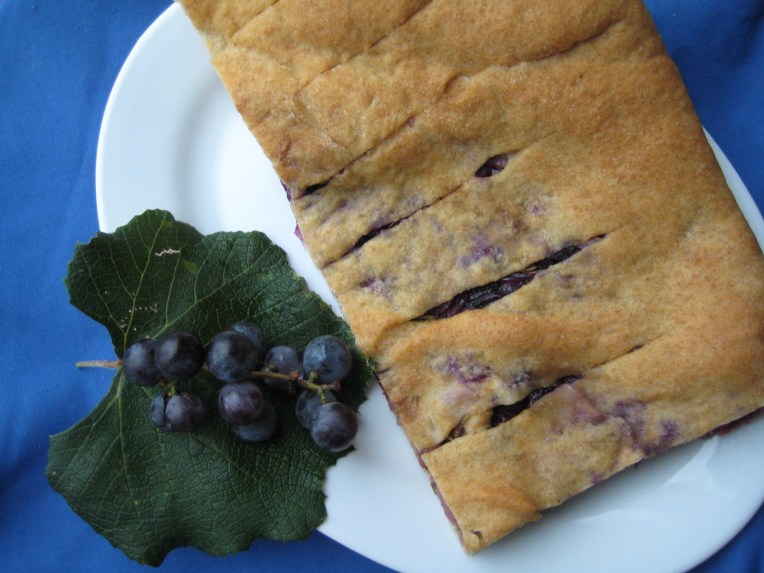
It came out just the way I hoped and I know I will want to eat this again when grape season is over. So now I will freeze the grapes in customized portions. Getting stuck with a bunch of concord grapes isn’t so bad after all.

Stuffed Flatbread with Concord Grapes, Red Onion and Rosemary

I use a round cast-iron pizza pan as a baking stone. Since I don’t have a pizza peel, and I don’t master the art of swiftly transferring a large piece of floppy dough onto the hot stone, I placed it on a large piece of parchment.

When I first made this, I seeded the grapes – a painstaking task. Pushing them through the food mill is much quicker and easier.

 2 teaspoons dry yeast

½ teaspoon sugar

2 cups all-purpose white flour

1 cup white whole-wheat flour

1 teaspoon salt

2 tablespoons extra-virgin olive oil, plus more for brushing

1½ cups Concord grapes

1 large red onion

1 tablespoon finely chopped fresh rosemary

Kosher salt

1. Mix the yeast with the sugar and ¼ cup warm water and stir to dissolve. Set aside for 10 minutes until it foams.

2. Put the flours, 1 cup warm water, the salt, olive oil and yeast mixture in the kitchen machine with a dough hook (if kneading by hand, mix in a bowl, then knead the dough on a clean work surface). Knead at low speed until the dough is smooth and elastic and detaches from the bowl. If too dry, add a bit more water; if too sticky, add more flour by the tablespoon.

3. Take the dough out of the bowl and oil the bowl. Put the dough back in the bowl, turn it once to coat evenly with oil, and cover the bowl with a kitchen towel, or cover it loosely with a lid. Let rise for 1 hour.

4. In the meantime, preheat the oven to 425 degrees F. Oil a gratin dish. Cut a large piece of parchment paper, slightly larger than the size of your baking stone.

5. Wash the grapes and slip off their skins. Place grapes into a bowl and place a food mill on top. Push the grapes through the food mill and extract as much of the pulp as possible without crushing the seeds.

6. Slice the onion thinly and mix them with grape pulp and skins. Roast in the preheated oven for 30 minutes, turning them a couple of times until they are soft and start to brown at the edges. Remove from the oven and cool. Turn off the oven but leave the oven door closed and place the baking stone on the middle rack of the oven (this will already preheat the stone for later).

7. On a lightly floured work surface roll out the dough about ¼ inch thick and to about double the size of your baking stone. Spread the onion grape mixture over half of the dough. Sprinkle with rosemary and salt. Fold the empty part of the dough over the stuffing, flatten it gently, and pinch all around to seal the edges.

8. Transfer the flatbread onto the prepared parchment paper. Diagonally slash the top every inch or so with a sharp knife. Brush with olive oil and let rise for 30 minutes.

9. Preheat the oven to 400 degrees F. When the dough is ready to bake, remove the baking stone from the oven. Transfer the parchment paper with the flatbread onto the stone. If you have a lot of excess parchment, carefully cut it off with scissors. Put the baking stone in the middle rack of the oven. Spray the flatbread with cold water and bake for 30 minutes until lightly browned. Remove the baking stone from the oven and slide the flatbread off the stone onto a cake rack to cool.