Know no shame, or: Anything for strawberries

Even after ten years in the country, I am squeamish as can be about anything furry – dead, alive, or in-between. Once our dog killed a groundhog in front of the garage door and it remained there until my husband returned from a trip to his parents a couple of days later. My mother-in-law, on one of my hysterical phone calls, recommended to cover it with an old towel, then load it onto a shovel, but just approaching the thing sent me screaming.

When it comes to protecting the new strawberry patch, however, I seem to be turning into a fearless, indelicate roughneck. The new commercial repellent I spread around the patch about a week ago seems to be working. But when I was weeding down there the other day and saw our dog lift his leg a few times around the patch, I had an idea. I had read somewhere that fermented human urine works as a critter repellent. Since we won’t be eating strawberries from the patch until next summer, and urine is sterile anyway, why not collect our own organic repellent? I sprinkled an old lemonade bottle full of donations around the perimeter of the patch twice this week. No rabbit damage so far!

But the next worry is already lurking around the corner. When I bought strawberries from our neighbor yesterday, he complained about half of his patch being affected by fungus because he had sprayed only once this season. Of course, now I am wondering what else will I have to battle after the rabbit plague, especially because I want to grow the strawberries organically, like the rest of the garden.

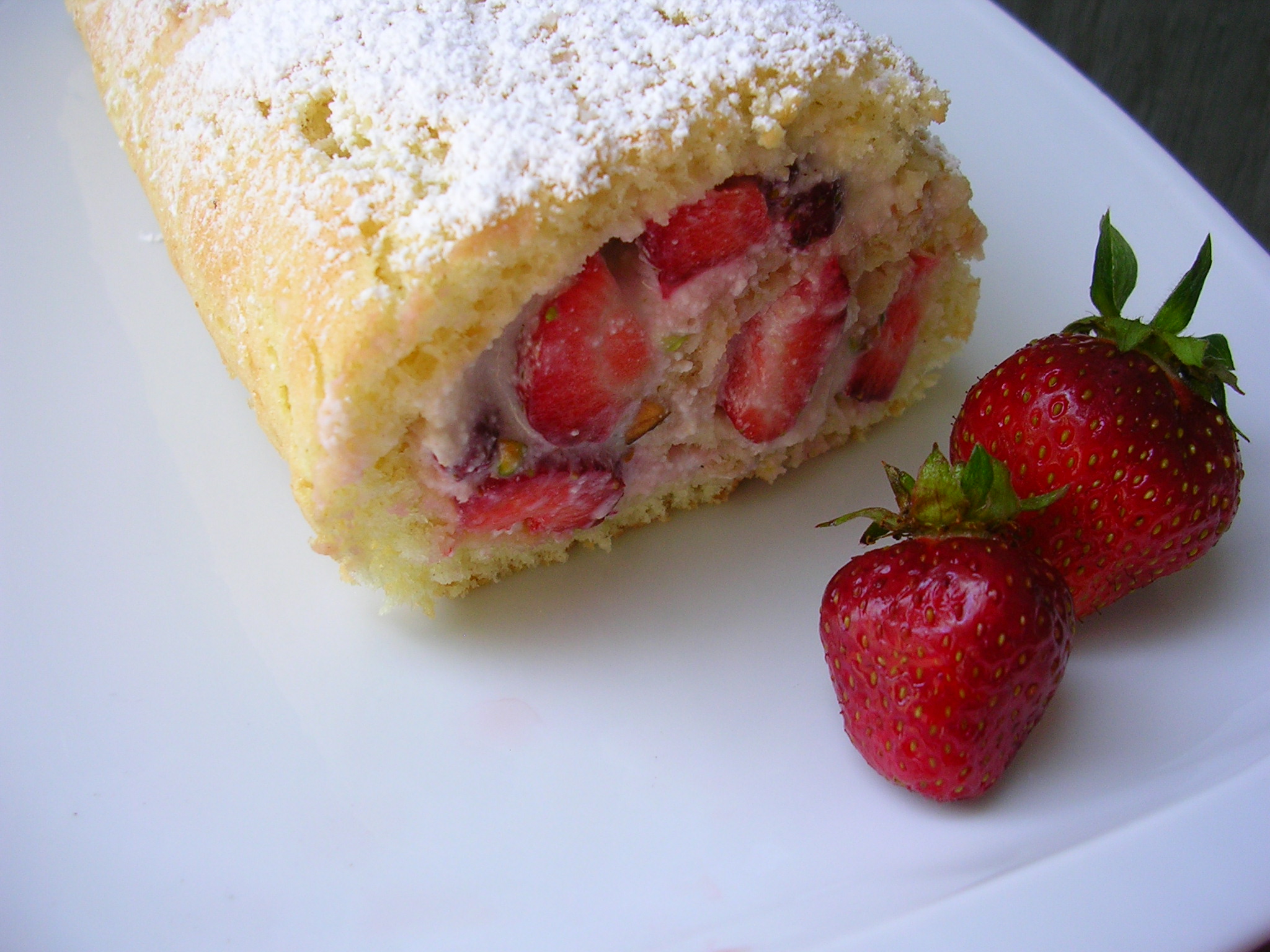
Enough kvetching, let’s get to the bright side of strawberries. Thanks to the healthy half of our neighbor’s strawberry patch, I was able to make another strawberry cake. It had to be something really easy and quick with the ingredients I had in the house, which was low-fat ricotta, but certainly whole-milk ricotta will make an even better, creamier filling.

Strawberry-Ricotta Roulade with Pistachios

Sponge cake:

2 eggs + 1 egg white

½ cup sugar

¾ cup flour

1 teaspoon baking powder

1/8 teaspoon salt

Filling:

¼ cup shelled pistachios

12 ounces strawberries

10 ounces ricotta

2 teaspoons vanilla extract

½ cup confectioner’s sugar, more for dusting

1. Preheat the oven to 400 degrees F. Line the bottom of a 16 x 11-inch jellyroll pan with parchment. Grease the parchment and the sides of the pan.

2. Beat the eggs and the egg white until light and fluffy.

3. Mix the flour with the baking powder and the salt and sift into the eggs. Fold it into the eggs lightly but thoroughly until no more flour pockets remain.

4. Pour the dough into the jellyroll pan and smoothen it with a spatula.

5. Bake in the preheated oven for 10 minutes, or until golden and springy to the touch.

6. Lift the parchment with the sponge cake onto the kitchen counter or a baking sheet and cover immediately with a clean dry kitchen towel. Let cool.

7. Lightly toast the pistachios. Cool, then chop and set aside.

8. Beat the ricotta with the vanilla extract and the confectioner’s sugar until smooth and creamy.

9. Wash, hull and slice the strawberries.
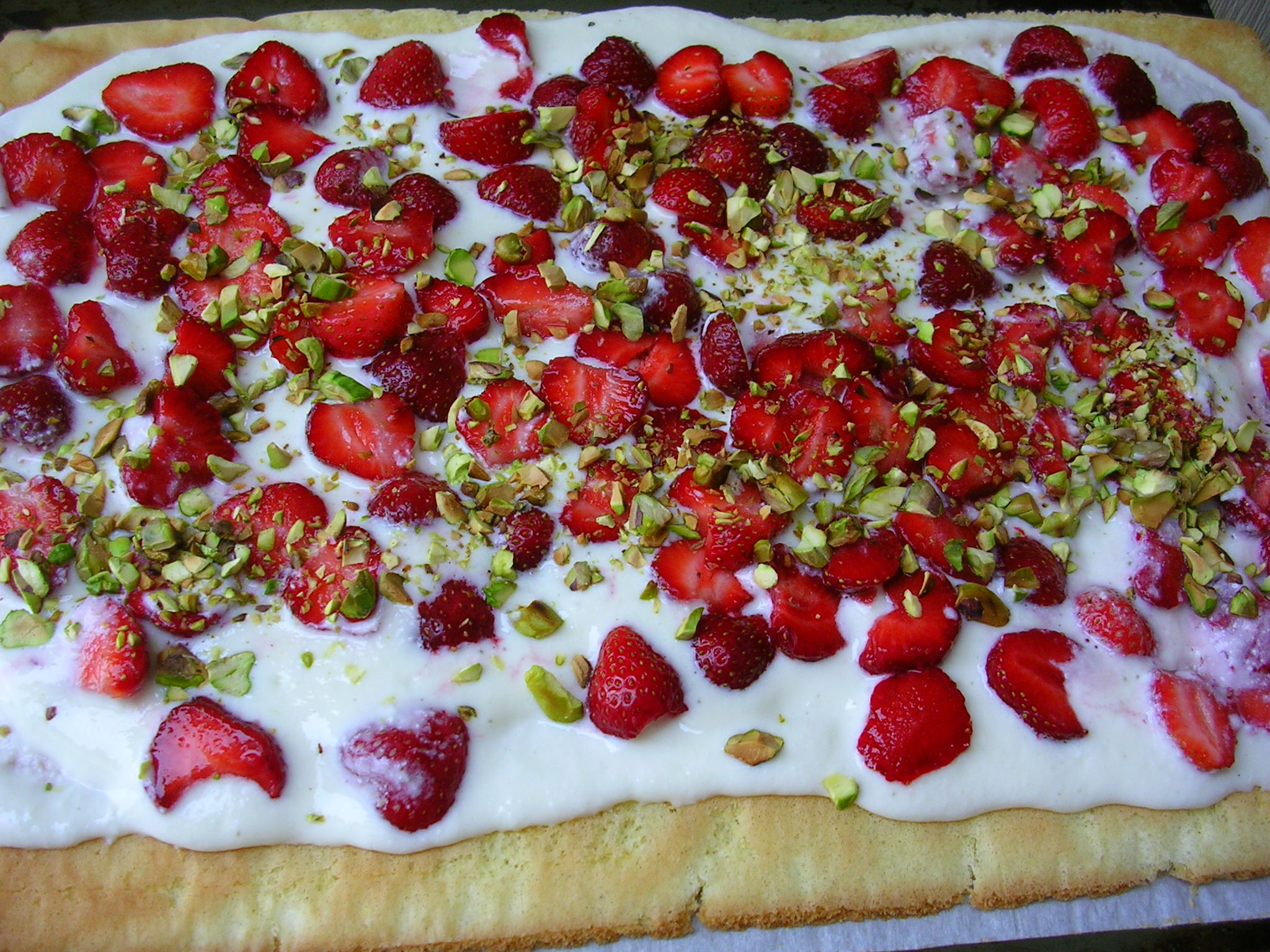
10. Flip the parchment with the sponge cake over and place it on a large baking sheet lined with the kitchen towel or with parchment. Carefully remove the parchment from the baking of the sponge cake.

11. Spread the ricotta evenly over the sponge cake, leaving about ½ inch uncovered on the long sides. Spread the sliced strawberries on top and sprinkle with the pistachios.

12. Using the towel as a lifter, roll up the cake from the long side. Place the roulade with the seam-side down on a serving platter. If you are making this just en famille, and not for fancy presentation, or if you don’t. have a platter long enough, cut it in half to fit, (that’s what I did). Chill for 1 hour. Dust with confectioner’s sugar before serving.
Bunny wars (cont.)

I did not do my homework, or I was naïve, or both, thinking that the rabbits would leave my new strawberry patch alone. They are systematically eating their way through the rows. I should have known better – pet rabbits are given strawberry leaves as a treat. Fencing in the strawberry patch is out of the question because to really keep the bunnies out, the fence needs to be galvanized hardwire cloth, buried 6 inches in the ground and at least 3 feet high, like my vegetable garden. Even a stubborn gardener like me must admit that this is not economical for a strawberry patch, and very labor-intensive.
But I wasn’t ready to give up just as yet so as a last attempt (all products I have tried in the past did not work), I bought Plantskydd, an organic rabbit repellent from Sweden that is supposed to do miracles. With one leaf left on a plant, so I learned, the strawberries might survive the onslaught. If in a week or so, the new leaves are not chewed off, the stuff works. Until then, I am not getting my hopes up too high.

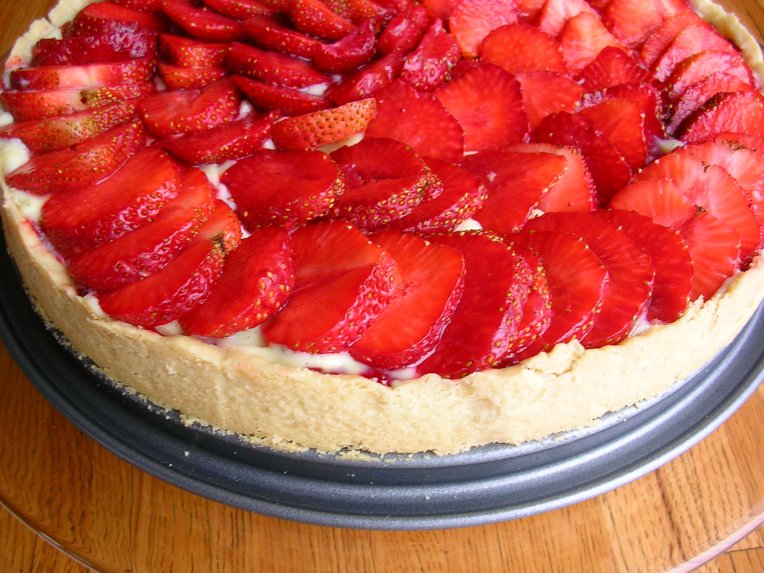
Fortunately, our neighbor, a part-time farmer, grows strawberries. He has supplied us with super-ripe strawberries twice this week. This strawberry cake was an impromptu operation so I used what I had on hand. For the lining of the crust, I made a small batch of strawberry jam of the ripest strawberries. Unless it’s top-quality or homemade, I find most strawberry jams nothing but sugary so this was more than a solution borne out of necessity.Strawberry Cake with Vanilla Custard
Crust:

¾ cup + 2 tablespoons (125 g) all-purpose flour

2½ level teaspoons baking powder

½ cup (100 g) sugar

1 teaspoon vanilla extract

4 eggs

3 tablespoons lemon agrumato olive oil (or lemon-infused olive oil)

2 tablespoons apple cider vinegar

1 pinch salt

Filling:

1¼  to 1½ pounds washed and hulled strawberries

Strawberry jam for brushing

1 batch homemade vanilla pudding (recipe is on my other blog, Spoonfuls of Germany)

1. Preheat the oven to 400 degrees F (200 degrees Celsius). Line a 10-inch (25 cm) cake pan or springform pan with baking parchment and grease the sides.

2. Add all ingredients for the crust to a bowl and beat with an electric mixer until combined, then beat at high speed for 1 minute. Pour into the prepared pan.

3. Bake for 15 to 20 minutes until firm and golden. Remove from the oven, let cool slightly then unmold onto a cake rack and let cool completely.

4. Brush the cake with jam.

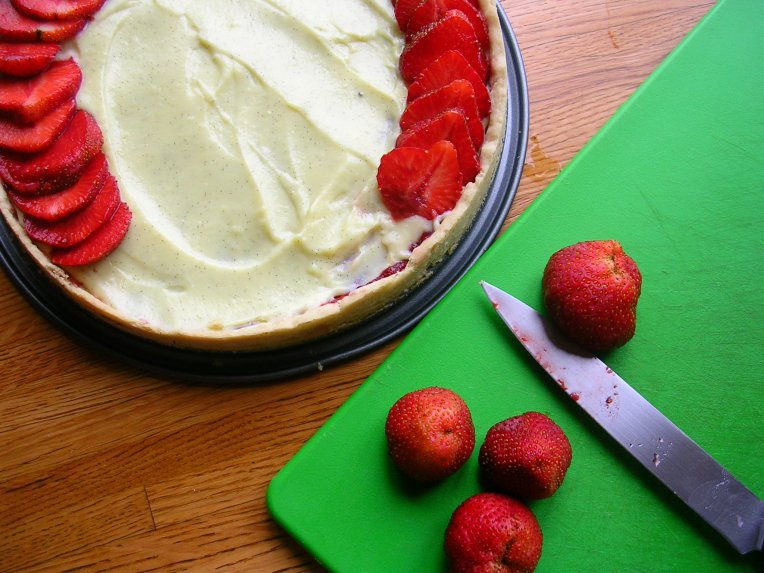
5. Prepare vanilla pudding following recipe. Spread on cake while still lukewarm, leaving about ½ inch (1.25 cm) free all around to give the custard room to spread without dripping down the sides.

6. Wash and hull strawberries and arrange in an overlapping shingle pattern. Refrigerate and serve within a day.

Makes 1 cake 

Long shortcut


I had wanted to make the Deep-Dish Rhubarb Pie from Sarah Leah Chase’s Open-House Cookbook for a long time. Yesterday I finally did it – it took several years for my two rhubarb plants to be strong enough to harvest at once the amount of rhubarb the recipe requires.

Chase’s cookbook is from 1987 and yet another proof that good cookbooks do not need stylish food photography, in fact, there is not a single photo except for the author’s, with an unmistakably 1980’s sweater and hairdo. The book came to me through my husband’s trousseau (he doesn’t cook).  It was one of the cookbooks his mother must have given to all of her children because I have spotted it on the cookbook shelves of my husband’s siblings.

This rhubarb pie is an adaptation of the recipe.

For the lattice crust, I decided to take a shortcut. Or so I thought, because I am not really good at making lattice crust, and I wanted to avoid lengthy fiddling with strips of dough while there is so much weeding, planting and pruning to do right now. Instead I cut out small cookies and placed them on top. This might have taken just as long as producing a lattice! At least I could be sure of a decent result.

Rhubarb can make a runny pie so depending on the freshness and thus moisture content of your rhubarb, you need to increase the amount of cornstarch in the filling. My pie was a bit on the runny side but I thought the filling is yummy as is, so I wouldn’t want to cut back on the amount of cassis, and rather adjust the amount of thickener next time.

Rhubarb Pie with Cassis

Filling:

2¼ pounds diced rhubarb (about 8 cups)

¾ cup Crème de cassis (black currant liqueur)

Grated zest of 2 organic oranges

A little less than 1½ cups (10 ounces) sugar

¼ cup (1 ounce) cornstarch, more as needed

Crust:

2½ cups flour

6 tablespoons cold butter

1/3 cup (2¼ ounces) shortening

¼ cup sugar

1 teaspoon powdered ginger

Pinch of salt

About 4 tablespoons ice water, as needed

1. The night before mix the rhubarb with the cassis and the orange zest in a non-corrosive container. Cover and refrigerate.

2. Cut the butter in chunks and put it in the food processor with the shortening, sugar, ginger and salt. Process until the mixture is crumbly and pebbly, then gradually add tablespoons of ice water and pulse until the dough forms a ball. Place the ball in an airtight container and refrigerate for at least 4 hours.

3. Drain rhubarb and pour the liquid in a saucepan. Set the rhubarb aside. Whisk the sugar and the cornstarch into the liquid and slowing bring to a bowl, whisking constantly. Cook until it turns clear and thickens. Add more cornstarch, a tablespoon at a time, until you get a very thick consistency. Cook to turn clear after each addition, and only then add more cornstarch.

4. Preheat the oven to 350 degrees F.

5. Roll out half of the dough to a 12-inch circle to fit a 10-inch cake pan. Lightly spray the pan with baking spray and fit the dough into the pan, trimming the edges.

6. Mix the rhubarb with the thickened liquid and pour it into the pan.

7. Roll out the remaining dough and cut out small cookies of your fancy. Place them closely together on top the filling.

8. Bake the pie in the preheated oven for 55 minutes to 1 hour. Let cool completely before cutting.

Makes 12 servings

Cracker trial

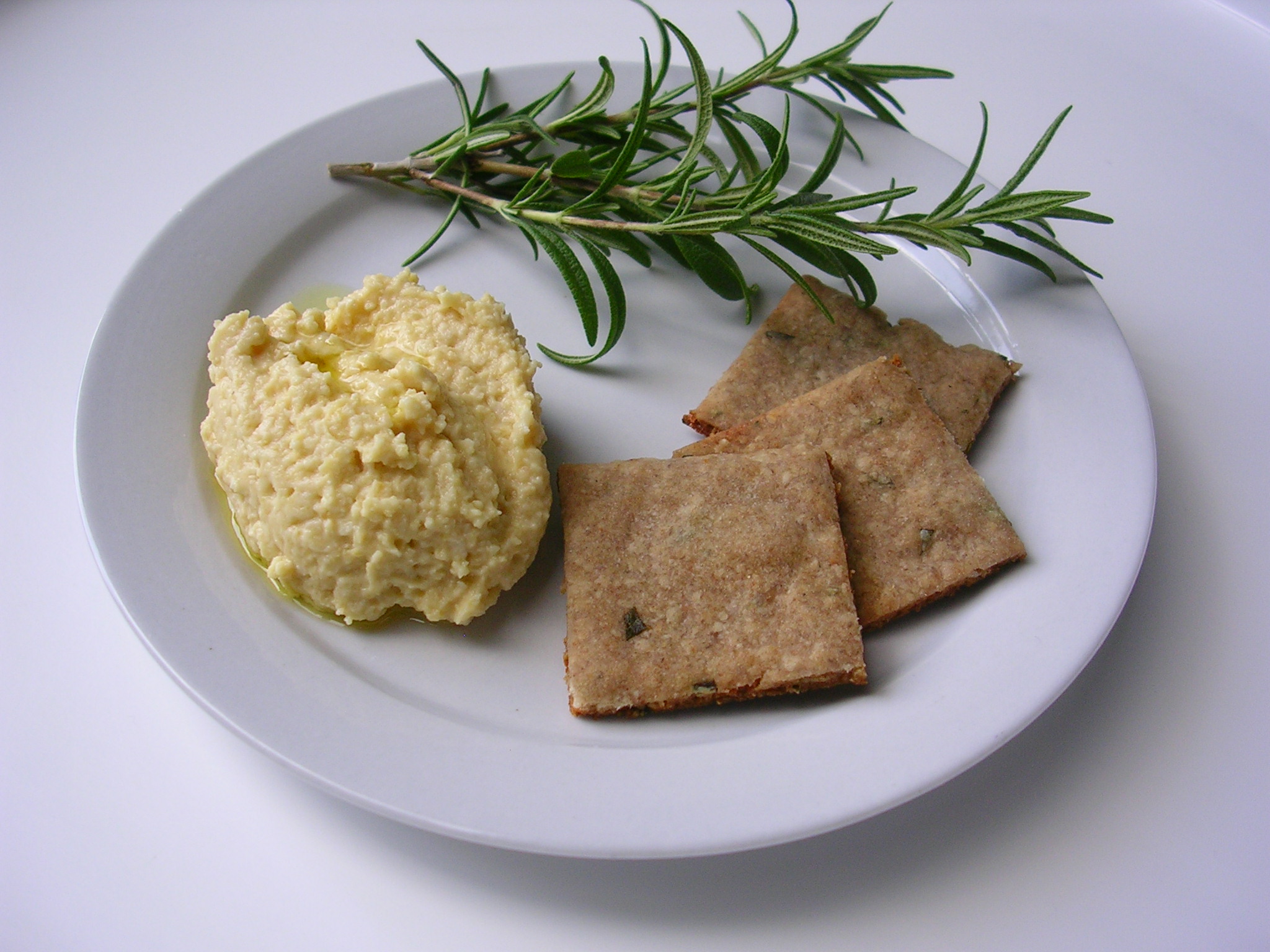
Baking something that is so readily available is not obvious. But lately I haven’t been able to find our favorite crackers, the Kashi stoneground 7-grain crackers, in stores. Also, the rosemary plant that moved from its winter home in the guestroom to the patio is so full and bushy that not using rosemary often makes me feel guilty each time I walk by and inhale the wonderful scent. And, finally, I had buckwheat flour that needed to be used up, as it does not have a very long shelf life. Three good reasons to try my hand on crackers.

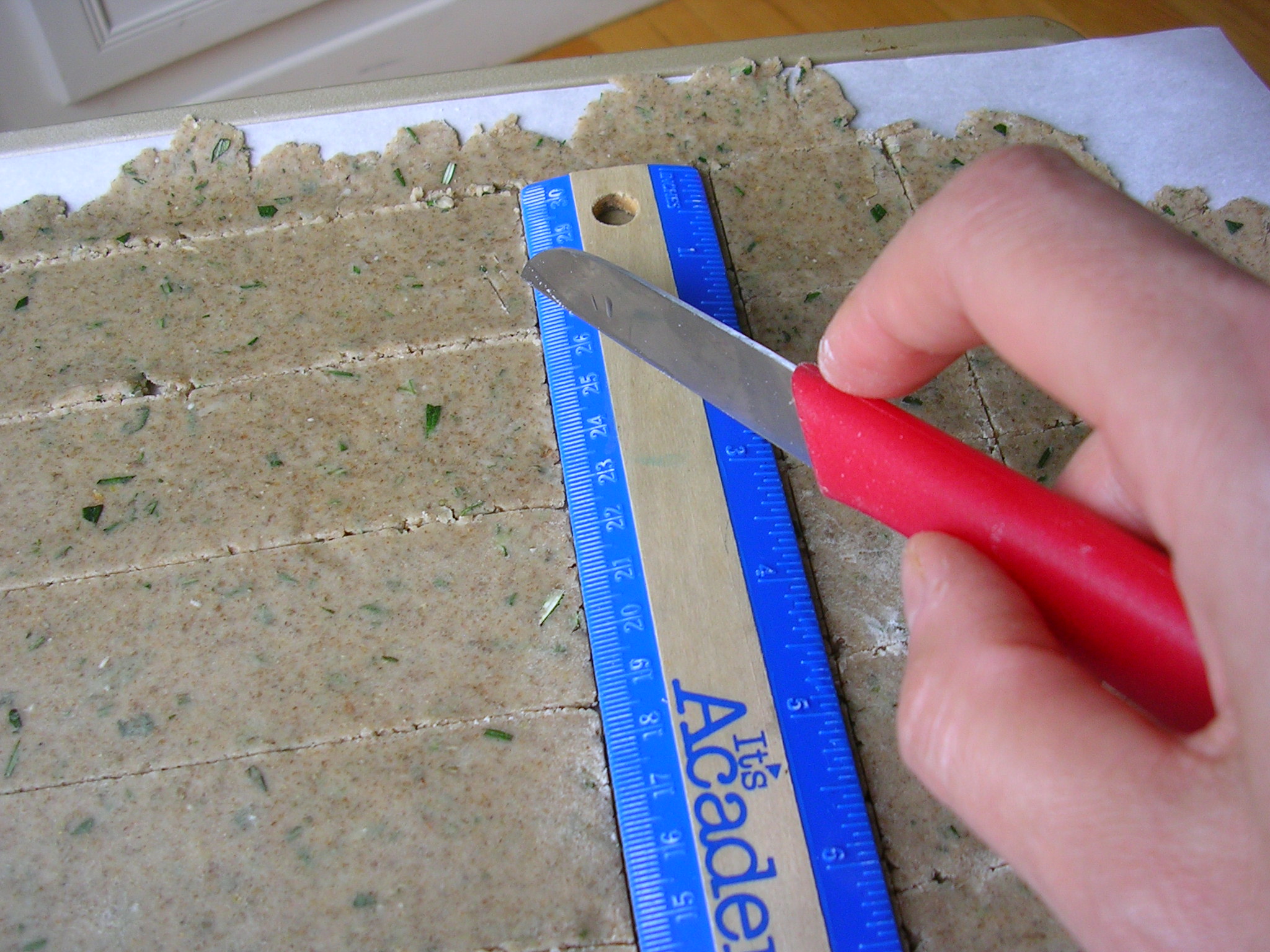
I used solid Amish farmer’s cheese but I doubt it is easily available outside Pennsylvania. Substituting it with well-drained Greek yogurt should work as well. The crackers might just end up a bit moister and might require a tad longer baking and a bit more salt, as Amish farmer’s cheese is saltier than Greek yogurt. I wanted the crackers to be even so I cut them with a ruler but that’s just me being a neatnik… For a more rugged look, just break the sheet in pieces after baking.

Buckwheat Rosemary Crackers

3½ ounces buckwheat flour

3½ ounces rye flour

1 level teaspoon baking powder

1 teaspoon salt

3 tablespoons + 1½ teaspoons cold butter (1¾ ounces)

3 ounces solid farmer’s cheese

1 heaping tablespoon Greek yogurt

3 tablespoons + 1 ½ teaspoons 2% milk (1¾ ounces)

2 tablespoons finely chopped fresh rosemary

1. Put the flours, baking powder and salt in the food processor. Dice the butter and the farmer’s cheese and add. Process until the mixture is crumbly.

2. Add the yogurt and milk and process until the dough forms a homogenous mass and sticks together in a ball.

3. Transfer to a bowl and quickly incorporate the rosemary using the tips of your fingers. Do not overwork the dough. Cover and let rest for 45 minutes.

4. Line a large (14×16 inch) baking sheet with parchment paper. Dust with flour. Roll out the dough directly on the parchment with a floured rolling pin. The dough should fill the entire sheet. You can patch the dough as needed but make sure to smoothen out the sutures.

5. Cut the dough into 1.5-inch squares using a ruler and a sharp knife. Place the baking sheet in the middle rack of the cold oven. Set the oven to 375 degrees F and bake until the crackers are lightly browned. Depending on the time it takes your oven to reach the set temperature the crackers might already be done at that point (mine were).

6. Transfer the parchment with the crackers onto a cake rack and cool slightly. Break the crackers apart and completely cool on the rack. Store in airtight tin containers.

Makes about 80 crackers