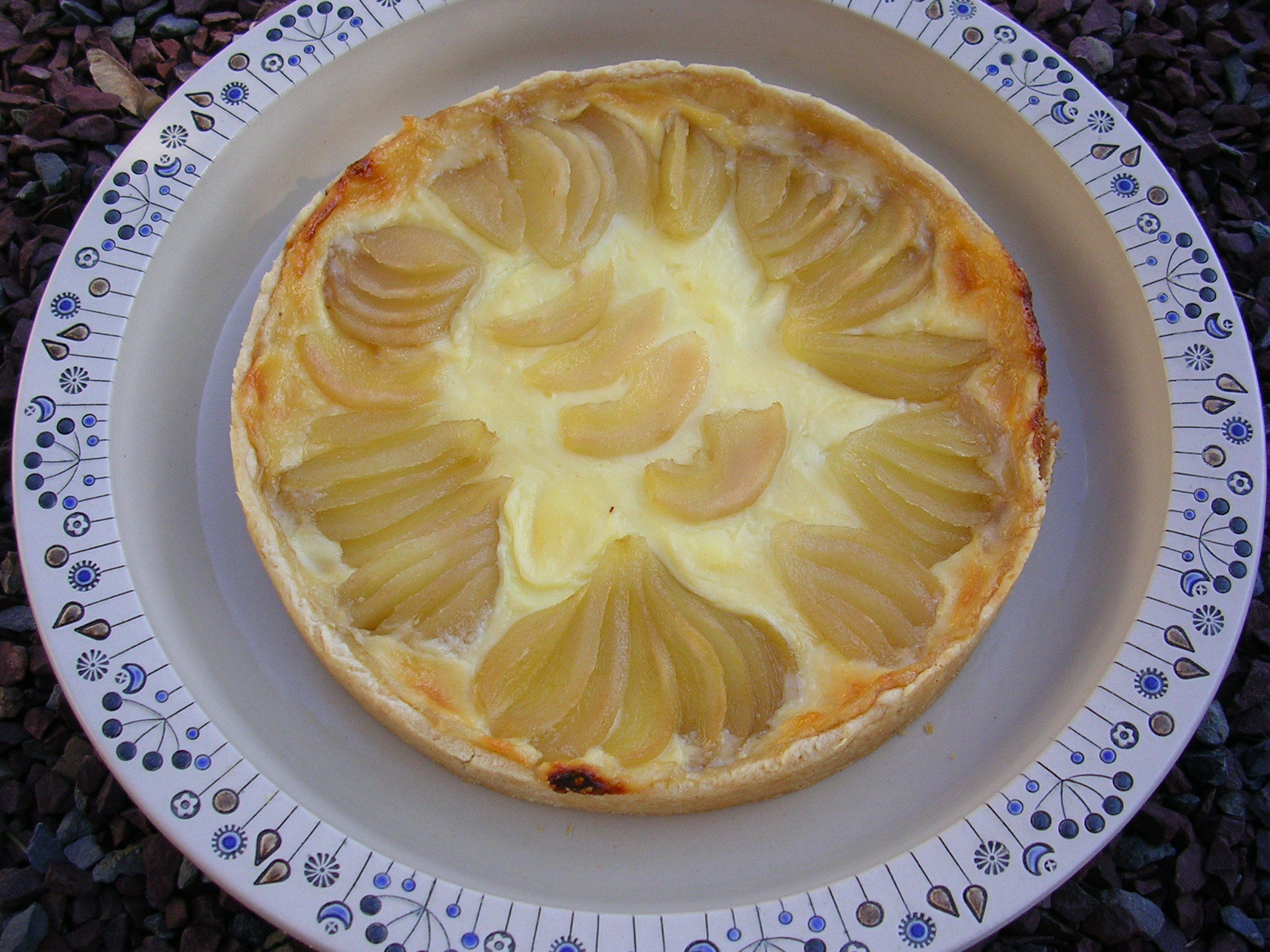
Empowering pear pie

After a major power outage, just grinding coffee in the morning feels fantastic. The freak snowstorm left us without power for a little under three days, about the same amount as after Hurricane Irene but the loads of heavy snow caused quite a bit of damage on our trees. On my way to the orchard to buy pears yesterday I had to make a detour, as some roads are still closed.

When the power is back, and the mess of candles, dirty dishes, laundry, candle wax, water buckets and other remnants of living without electricity is cleaned up, I usually tackle the fridge and the freezer, throwing out soggy frozen herbs (wondering each time why I even bother freezing them, those are the first to spoil), and cooking with whatever can be saved.

It always takes me a few days to switch from the rescue cooking mode to the fun cooking mode. Today was the day. The gorgeous fall weather simply called for a pear pie. It is hard to believe that a week ago I walked around in snow boots knocking off a foot of snow from trees and shrubs.

For the pear pie filling I used pre-cooked custard, which is common in German recipes. It makes the pie wonderfully moist without being too sweet. I used Dr. Oetker Cream Pudding, which is available in the United States. The brand’s Vanilla Pudding can be used instead, which is even more widely available.

Pear Pie with Custard

Crust:

2½ ounces shortening

1 cup flour

¼ teaspoon salt

Ice water as needed

Filling:

1 package Dr. Oetker Cream Pudding (or Vanilla Pudding)

2 cups low-fat milk

¼ cup sugar

Topping:

3 slightly underripe Bosc pears

½ cup dry white wine

½ cup + ¼ cup sugar

1 teaspoon grated organic lemon zest

2 tablespoons Amaretto

1. For the crust, put the shortening, flour and salt in a food processor. Pulse to a crumbly consistency. Add just enough ice water, one tablespoon at a time, to the dough so that it forms a ball.

2. Roll out the dough between to sheets of wax paper to fit a 9-inch greased springform pan plus a 1-inch edge all around. Remove the upper layer of the wax paper and flip the crust over into the pan. Even out the edge and place in the freezer.

3. For the filling, mix the custard powder with a few tablespoons of the cold milk and the sugar. Stir until smooth.

4. Bring the rest of the milk to a boil. Remove from the heat and whisk in the custard mix. Put it back on the burner and cook for about 1 minute, stirring vigorously, until the custard thickens. Remove from the heat and let cool, whisking every so often.

5. For poaching the pears, bring 2 cups of water, the wine, ½ cup sugar and lemon zest to a boil in a wide pot or a deep skillet. Stir to dissolve all the sugar.

6. Peel the pears and cut them in half. Remove the cores and place the pears in the poaching liquid. Reduce the heat and simmer for about 15 minutes, until the pears are easily pierced with a knife. Turn them once or twice during poaching.

7. Drain the pears (you can refrigerate and re-use the poaching liquid). Place the pears cut side down on a cutting board and cut them into even slices but do not cut them all the way through so that you can place them on the pie like a fan.

8. Preheat the oven to 350 degrees F.

9. Whisk the cooled custard. If it is lumpy, you can smoothen it by blending it with a stick blender for a few seconds. Pour the custard into the pan with the crust.

10. Place the cut pears on the custard in a circle, tips to the center. Fan them out as much as possible.

11. Mix the amaretto with ¼ cup sugar and drizzle over the pears.

12. Bake in the preheated oven for 35 minutes, then increase the heat to 375 degrees F and bake for another 30 to 35 minutes, until the crust and the top are golden. Let cool for 5 minutes, then pass a knife around the edge and carefully remove the rim. Let cool completely on a wire rack. Refrigerate until serving but take out of the fridge 30 minutes before serving.
Lydia’s way


My late German grandmother would nod in approval if she saw me making this. Although she never said it openly, wasting food was taboo with a capital T for her. Having lived through World War II, her definition of “wasting” was certainly more extreme than my mother’s; and I am yet another generation removed from her parsimony. Still, not using the many egg whites that I have left over from making custards, puddings, crème caramel and the like would never occur to me.
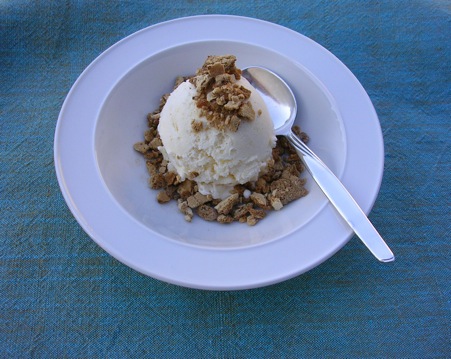
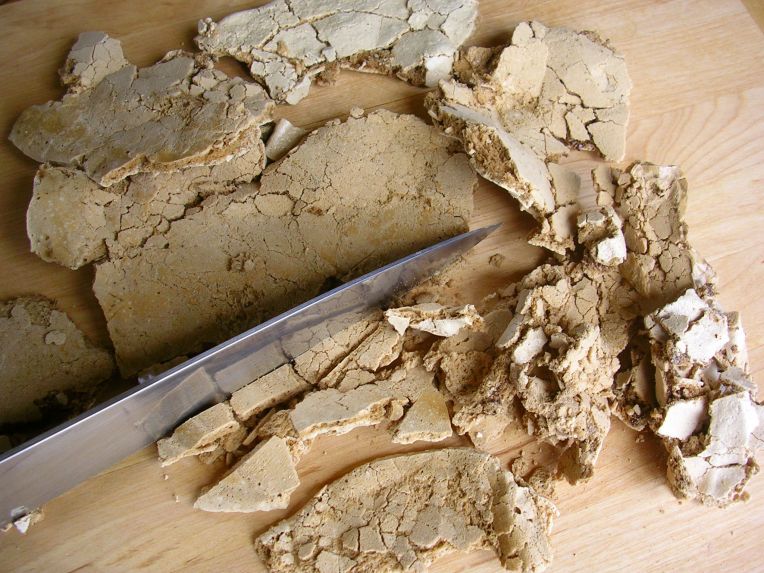
Since I cannot foresee when I will use them, I always freeze the egg whites in small containers. Mostly I use them for meringue cookies with chocolate or coffee flavor, a recipe adapted from The Joy of Cooking.

In July, when I was in charge of bringing ice-cream topping to a meeting of my Master Gardener group, I turned my usual meringue cookies into a crushed version.  I have had several requests for the recipe so here it is:

Crushed Meringue for Ice-cream Topping

3 egg whites

1 cup (200 g) sugar

2 to 3 tablespoons instant espresso or unsweetened cocoa, to taste

Canola oil or another neutral-tasting oil for spraying

Pinch of salt

1 teaspoon vanilla extract

1. If using frozen egg whites, thaw them in the refrigerator.

2. Mix the sugar with the instant espresso.

3. Preheat the oven to 250 degrees F. Line a jelly roll pan with aluminum foil sprayed with oil.

4. Beat the egg whites with a pinch of salt until they are very stiff, gradually adding the sugar and the vanilla.

5. Spread the batter evenly onto the aluminum foil and bake for 60 minutes, until dry to the touch. Remove the pan from the oven but leave the oven on.

6. Transfer the meringue onto a large cutting board and peel off the aluminum foil. It’s OK if it breaks into many pieces, as it will be crushed anyway.

7. Coarsely chop the meringue with a large knife and spread it out on the aluminum foil. Bake for another 30 minutes, until the meringue has barely any moist spots left. Turn off the oven but leave the meringue in with the door closed, which will dry it further.

8. After the meringue is cooled completely, store in tin cans. It keeps for several weeks.

Oy whey

Last week it was apricots, this week it’s yellow plums that are at their peak at the local orchard. Fruits and veggies don’t care about editorial diversity. Soon I shall be writing about homegrown tomatoes twice in a row.

I bought The Essential New York Times cookbook a couple of weeks ago and I know it will be my main reading for the rest of the summer. As for cooking from it, I wanted to begin with something really easy so I made ricotta – for the first time. It was easy, though I am not sure I will make it again, for two reasons.

When it was all over, I had almost a gallon of whey left over. Being the thrifty cook that I am, I could not possibly just dump it down the drain. So I froze it in 3-cup batches, enough to bake 10 loaves of bread. I only bake bread about every ten days, so I quickly realized I would soon have nothing in the freezer chest but whey. Also, I must have drained the ricotta for a bit too long, although I did not squeeze it as the recipe instructed.

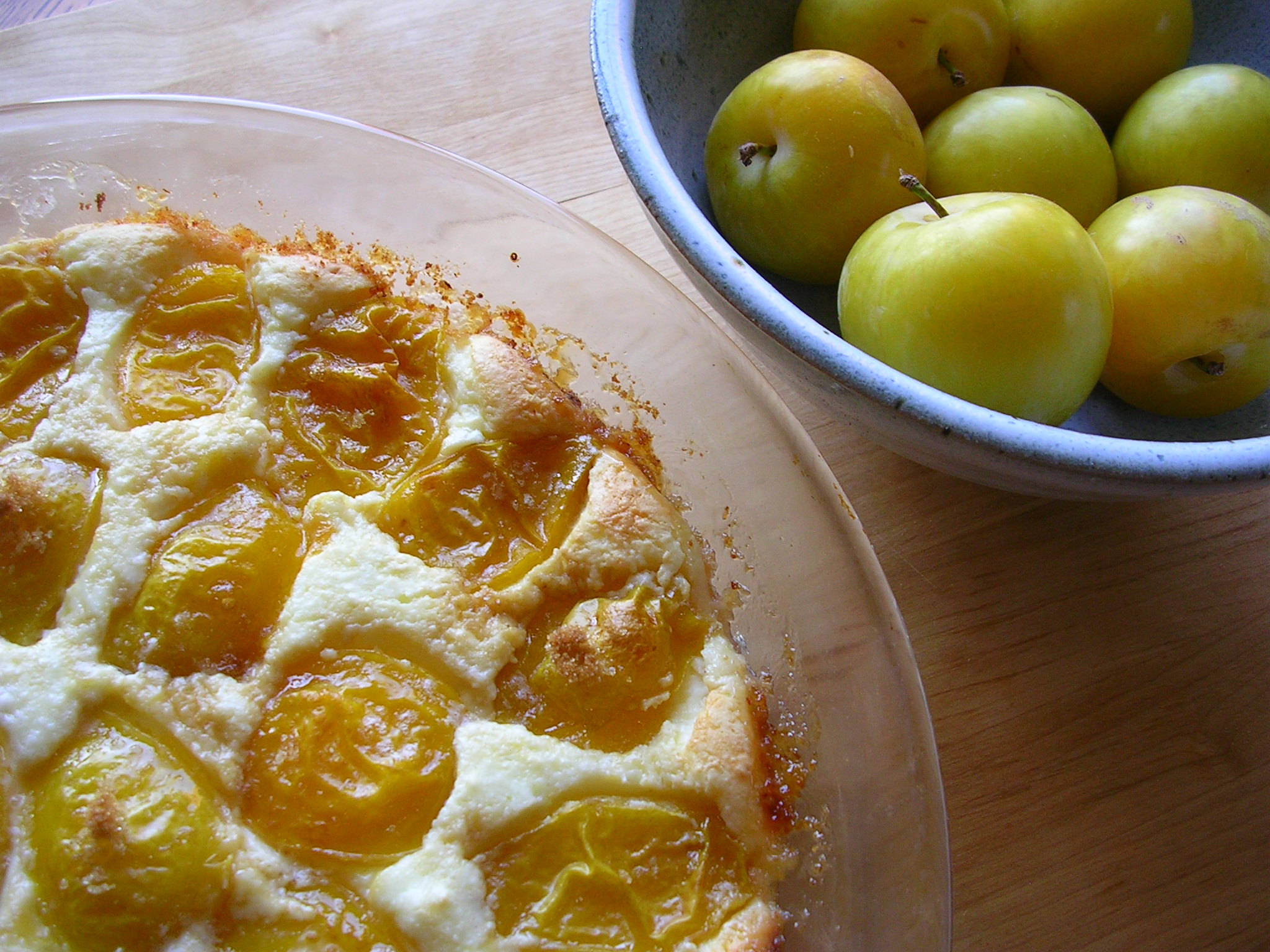
To use up the ricotta, I remembered the Ricotta Cheese Pie from The Joy of Cooking as very good. I took my cues from that filling, but modified it to a crustless pie. Because the yellow plums were so juicy, it did not matter that the ricotta was a bit on the dry side.

Whether I make ricotta again or not, and whether you call this baked custard or crustless pie, I got myself a new recipe for a quick and light summer dessert.

Crustless Ricotta Pie with Yellow Plums

1 tablespoon butter + more for the pan

Breadcrumbs

1 pound well-drained ricotta

2 eggs

2 teaspoons finely grated lemon zest

2/3 cup sugar

Light brown sugar

8 ripe yellow plums

1. Preheat the oven to 375 degrees F.

2. Butter the bottom and sides a 9-inch pie pan and sprinkle with breadcrumbs. Turn it upside down over the sink and knock off any excess crumbs.

3. Beat the ricotta, eggs, lemon zest and sugar with an electric mixer until well combined.

4 Pour it into the prepared pan and spread evenly with a spatula.

5. Halve the plums and remove the pits (this usually works best when twisting them slightly but sometimes the pit clings. In that case remove the pit with a small paring knife.

6. Arrange the plum quarters in circles on the filling. Dot with butter and sprinkle with brown sugar.

7. Bake 30 to 40 minutes in the preheated oven, or until the pie is set but still a bit wobbly, and lightly browned on top. Serve lukewarm or cold.

Apricot tart, juicy and impromptu

My baking is often quite unorthodox. I start with a recipe, then change course mid-way, hoping it will work out. This time I had a basket full of beautiful, super-ripe apricots from a local orchard sitting on the counter. The apricots were so juicy that I feared the crust would turn soggy if I placed the apricots directly on the dough. So I turned the recipe upside down. I sprinkled the dough with the sugar-almond mix that was supposed to go on top, and made another batch of the almond-sugar mix for the topping. In fact the apricots were so juicy that as an additional precaution, I placed a jelly roll pan on the rack underneath to catch any drippings, and I am glad I did.

I took notes just in case the apricot tart would turn out fine. It did! Here is the recipe:

Apricot Tart:

Crust:

1 1/3 cups flour

1 stick chilled unsalted butter, cut into chunks

1/3 cup + 1 tablespoon sugar

Pinch of salt

1 egg yolk

Topping:

1/3 cup whole unpeeled almonds

1/3 cup sugar

4 tablespoons apricot preserves

1.5 pound ripe apricots

1. Place the flour and the butter in the food processor and process to a crumbly consistency. Add the sugar, salt and egg yolk and process until the dough forms a ball. Put the dough in a container with a lid or in plastic wrap and place in the freezer for 20 minutes.

2. Toast the almonds in an ungreased pan. Cool, then grind in the food processor with 1/3 cup sugar.

3. Butter a 9-inch tart pan (I used one with a removable bottom) and sprinkle with 1 tablespoon of the almond mix.

4. Preheat the oven to 400 degrees F.

5. Roll out the dough between two pieces of wax paper to a 11-inch circle. Fit the dough into the tart pan with the dough coming up the sides. Trim extra dough with a knife or gently even it out by pinching it together with your fingertips. Sprinkle with half of the remaining almond mix.

6. Wash the apricots and dry well. Cut in half and remove the pits. Place the apricots on the dough cut-side down; they should fit snugly.

7. Warm the apricot preserves and strain them through a fine sieve and brush the apricots with it. Sprinkle with the remaining almond mix and bake in the preheated oven for 40 minutes, or until the crust is golden. Let cool on a wire rack.