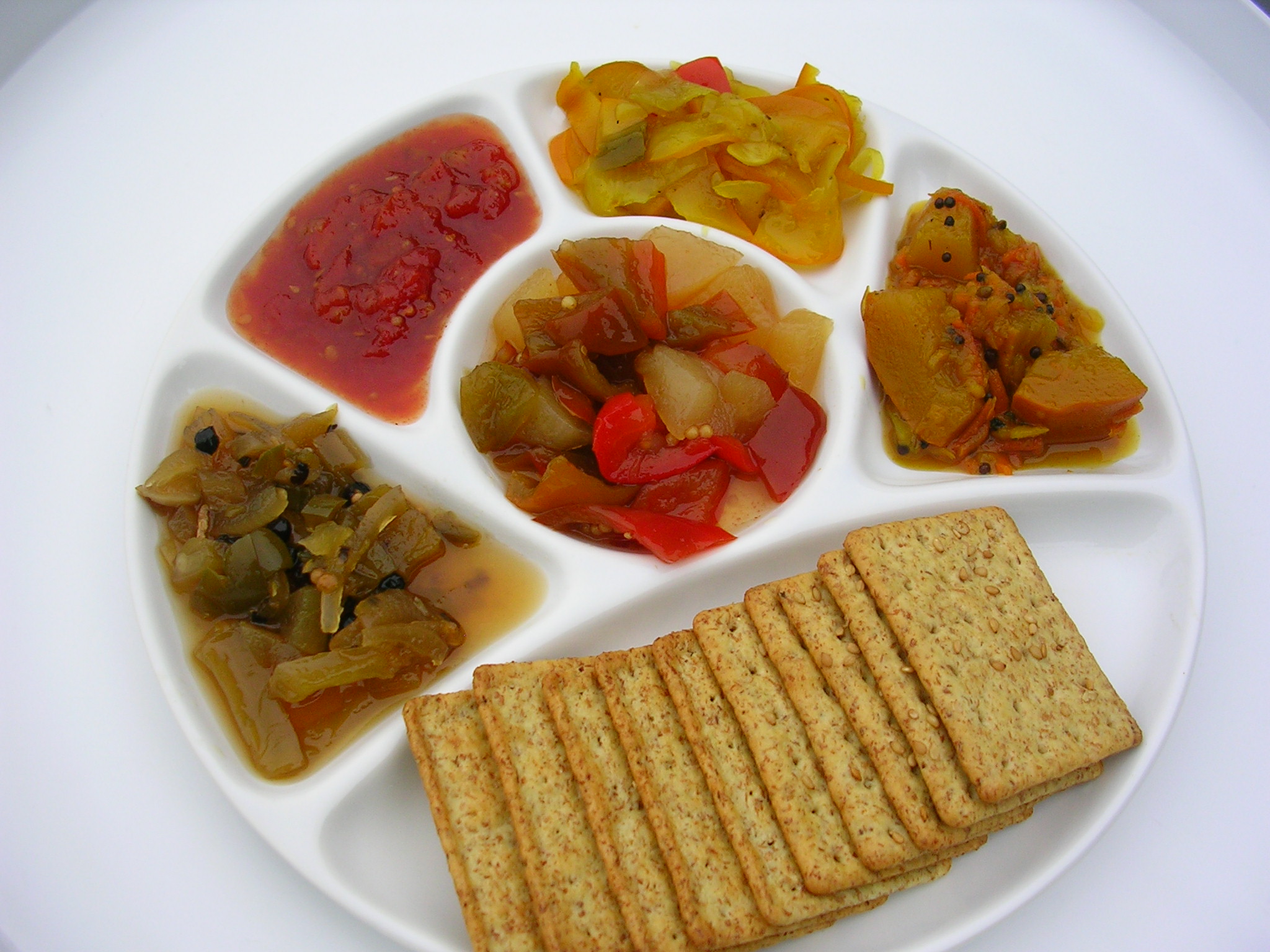
Pickle plate, palate teaser


Kelly Geary, author of the preserving cookbook Tart and Sweet, was quoted in a recent issue of Organic Gardening saying that she orders a pickle plate whenever a restaurant has it on the menu. “A pickle plate,” I thought, “what a neat idea. I have canned enough stuff to make one of those at home!” And so I did.

My pickle/relish/chutney plate included my Zucchini RelishGreen Tomato ChutneyGolden Zucchini Chutney, and Red Pepper and Apple Relish (photo center; recipe below). Plus, Mark Bittman’s fabulous Tomato Jam, which I have made every year since the recipe appeared in The New York Times in 2008.

When tasting the different pickles and relishes all at once (not plain though, we had it with rustic whole-wheat bread, crackers, salami, a couple of hard cheeses, and a glass of chilled Vidal Blanc), I was relieved that I did like all of them. But the greatest surprise, given that I just overcame my green tomato apprehension this summer, was that the Green Tomato Chutney was probably my favorite.

Like all the other pickles, the Red Pepper Relish was the result of an overabundance. I had a bumper crop of red peppers this year.

In the past I often ended up with jars that contained mostly liquid. Therefore I now drain the cooked solids before filling the jars. Only then do I add as much liquid as is needed to fill the jars, and discard the rest.

Red Bell Pepper and Apple Relish

8 large red bell peppers

4 large tart apples

3 cups cider vinegar

2½ cups sugar

4 teaspoons yellow mustard seeds

½ teaspoon cayenne pepper

2 teaspoons salt

You also need:

A canning pot, or a very large stockpot

Canning jars, bands, and new (unused) lids

1. Cut the bell peppers in half and remove the seeds and dividing membranes. Cut into ½-inch pieces. Peel and quarter the apples and remove the core. Cut into 1-inch cubes.

2. Combine all ingredients in a large heavy pot and slowly bring to a boil. Stir until the sugar is dissolved. Cook uncovered for 25 minutes.

3. Carefully ladle the piping hot relish into a colander placed over a large heatproof bowl. Fill the solids in sterilized jars placed on a damp kitchen towel. Add enough of the hot liquid from the bowl to cover the solids, leaving about ¼ inch headspace. If the liquid has cooled off, quickly reheat it in the pot.

4. Wipe the rim of the jars with a clean damp paper towel. Close jars with brand new lids and bands immediately and process in boiling hot water bath for 15 minutes.

5. Remove from the water onto damp kitchen towels and let sit for 24 hours. Store in a dark and cool place.

Makes three 1-pint jars

Discovery in pink

When an old friend of mine from Germany recently visited, he raved about the beet dumplings he and his family had on a vacation in Tyrol and started to prepare at home. Of course I wanted the recipe!

First I thought the dumplings were more of a side dish, and I should wait to serve them with some type of roast in the fall or winter. But then I realized they make a very satisfying vegetarian main course, similar to pasta.

The original recipe uses chopped parsley but I thought chives would give the dumplings more flavor. For the sauce, I concocted a cream sauce with wine and shallots.

I am thrilled with this discovery in pink and cannot wait to make the dumplings again when the fall crop of beets comes in.

Beet Dumplings with Shallot Cream Sauce

Dumplings:

1 tablespoon unsalted butter

1 small onion, finely chopped

3½ ounces cooked or steamed beets

2 eggs

1¾ ounces Gorgonzola

4½ ounces dried crustless white bread

3 tablespoons flour, more as needed

2 tablespoons snipped fresh chives

1 teaspoon salt

Sauce:

1 tablespoon butter

3 shallot lobes, finely chopped

¼ cup dry white wine

¾ cup heavy cream

Salt

Freshly ground black pepper

1. For the dumplings, melt the butter in a small skillet and cook the onion until translucent and soft, stirring often. Set aside to cool.

2. Process the beets with the eggs and the Gorgonzola in the food processor or blender until smooth.

3. Cut the bread in small cubes and place them in a large bowl. Pour the beet mix over them. Add the cooled onion and mix everything until well combined. Add 3 tablespoons flour and mix well. Add the chives and salt to taste. Cover and let stand for 15 to 30 minutes.

4. Bring salted water to a boil in a large pot. Reduce the heat to a mere simmer. Place a thumbnail-size test dumpling in the simmering water. If it holds, the consistency is fine; if it falls apart, add more flour to the mix, one tablespoon at a time.

5. With wet hands shape dumplings of about 1.5 inches in diameter and place them in the simmering water. Do not overcrowd the pot; the dumplings should not touch each other. Simmer until the dumplings float on the surface, about 10 to 15 minutes. When they are done, remove them with a slotted spoon to a warmed serving bowl. Cover with a lid to keep them warm.

6. While the dumplings are simmering, prepare the sauce. Melt the butter in a small saucepan. Add the shallots and cook until soft and translucent, stirring often. Add the wine and increase the heat. Cook until the wine has evaporated almost entirely.

7. Add the cream and reduce the heat. Simmer uncovered until the sauce has thickened, about 10 minutes. Season with salt and pepper. Pour the sauce over the dumplings and serve.

Makes 4 servings

The eternally dirty knees of a gardener

No matter how hard I try to stay clean, I always get dirty in the garden. I mean really dirty, to the point where need to take off my gardening clothes in the garage. The worst are my knees. Even after thorough scrubbing in the shower, rubbing them with alcohol or hydrogen peroxide, my knees still look dirty. This is a mystery to me because I always wear trousers in the garden – hand-me-downs from my mother who is trying to rid her house of decades of accumulated clothing, including old jeans of mine when I was in my twenties (surprisingly, they still fit me, gardening must indeed do something for the waistline).

My best guess is that my knees are not actually dirty but it’s more pressure points from being on my knees a lot, just like our dog has calluses on his elbows from frequent floor contact.

How could I possibly not be on my knees? Seeding minuscule seeds, thinning out tiny seedlings, and harvesting, especially digging out root vegetables, is practically impossible without crouching on the ground, unless you do raised-bed gardening. Today I dug out some lonely beets that I had overlooked all summer, and seeded another fall crop. The arugula needed thinning so I took some for this salad tonight. Of course, I did all of this… on my knees.

When the time comes where I cannot be on my knees any more, I shall move to raised beds. Until then, I will just have to accept dirty knees as the signs of a true gardener.

Beet Salad with Arugula and Feta

1.5 pounds beets

¼ cup extra-virgin olive oil

2 tablespoons balsamic vinegar

Salt

Freshly ground black pepper

1 small bunch baby arugula

5 ounces crumbled feta

3 tablespoons chopped fresh mint

1. Preheat the oven to 375 degrees F.

2. Wash the beets and put them unpeeled in a Dutch oven or cast-iron casserole with a tight-fitting lid. Pour in about ¼ inch water. Cook the beets in the preheated oven for about 40 minutes, depending on size, until they are easily pierced with a knife. If the beets are different in size, check them individually and take them out as they become tender.

3. Slip the skins off the beets and cut into 1-inch cubes. Set aside to cool.

4. Whisk the oil with the vinegar, salt and pepper.

5. Wash and dry the arugula and tear into bite-size pieces.

6. In a large bowl, mix the cooled beets with the arugula, feta, mint and dressing. Serve as soon as possible, as the arugula wilts quickly.

Makes 4-6 servings

After-the-storm elderberry sauce

After a power outage for two and-a-half days due to hurricane Irene, and the emergency evacuation of our freezer chest, filled almost to the top with produce from the garden, to friends who did not lose power, I had only limited energy left for lengthy food rescue operations.

The storm had knocked down several handfuls of elderberry clusters. Elderberries ripen unevenly so I usually leave them on the plant until all the berries are black, hoping I am quicker than the birds. The elderberry clusters I collected still had some green berries on them but that’s all right.

I have never made anything else than elderberry soup or jelly from elderberries. There were not enough storm berries for any of those but I know from Elderberry Soup that elderberries and apples are a good combination. So I made this easy after-the-storm elderberry sauce with apples. I had it with Greek yogurt but I can imagine it also delicious on cottage cheese, rice pudding, with waffles or pancakes.

Let’s hope we won’t have another storm like this in a long time but if we ever do, I will try the sauce with pears, which also complement elderberries very well.

Elderberry Sauce with Apples 

2 Gala apples

2.5 cups stemmed and washed elderberries

1 cinnamon stick

1 strip of organic lemon peel

½ cup sugar, to taste

1 tablespoon cornstarch

1. Peel and quarter the apples. Remove the core and cut the apples into ½-inch dice. Put them in a heavy saucepan with the elderberries, the cinnamon, lemon peel and sugar. Add 2 to 3 tablespoons water to prevent burning before the elderberries release their juice.

2. Bring to a boil and cook, covered, 15 minutes, until the apples are very tender and the berries are easily crushed with a spoon. Stir occasionally during cooking.

3. Cool slightly and remove the lemon peel and cinnamon stick. Pass through the finest plate of the food processor. Scrape the underside of the plate – a lot of the thick pulp gets stuck there.

4. Return the sauce to the pot. Dissolve the cornstarch in 2 tablespoons cold water and add it to sauce. Stirring constantly, bring the sauce to the boil and cook for another 2 to 3 minutes, until it thickens and looks no longer starchy. Taste for sugar. Let cool and refrigerate.

Makes about 1 cup