Memory lane

The herb garden is one of my favorite places to work – not only because of all the wonderful scents I take in, but also because every herb has its own story. As I move from plant to plant weeding and trimming, I think of the people who gave them to me, or the circumstances how, when and where I acquired them.

The chocolate mint is the oldest plant in the group. It actually started the herb garden. A red Japanese maple had just died the winter before and we did not quite know what to do with that sunbaked weed-filled area above a stonewall. I planted a lonely mint because I did not know what else to do – I was just getting into gardening at the time. When the mint thrived (of course it did, all mints do!) I was thrilled. It was pretty the way it grew over the wall so I made it a project to turn the whole area into an herb garden.

Today the herb garden is filled with more than two dozen culinary and medicinal herbs. Of course, like with everything else in gardening, there were several failures. Basil, dill, borage and parsley fall victim to the rabbits in a single night, therefore I must grow them in the fenced-in vegetable garden. Our hilltop winters are too rough for rosemary and lavender so those are in containers on the patio and overwinter in the house.

This morning, I was out in the herb garden early to make room for some herbs I bought at the Pennsylvania Lavender Festival yesterday. I was never a big shopper; shoe-buying sprees, for example, are totally strange to me (with shoe size of 11, I don’t want to attract too much attention to my feet anyway) but I can get a bit out of control when it comes to kitchen tools and plants. Therefore I had asked my friend to put me on a leash and not let me buy more than five plants. I stuck to it and came home with two culinary sages, rue, St. John’s worth, and winter savory. If they make it through the winter, they will not only be beautiful additions to the herb garden, but also bring back memories of a great early summer outing.

Lemon Balm Granita

1 cup packed lemon balm leaves (about 1.5 ounces)

3 cups boiling water

Sugar to taste

Dash of lemon juice

1. Wash the lemon balm leaves. Rip them apart with your hands or chop coarsely and place in a heatproof bowl or teapot.

2. Add the boiling water and let steep 30 minutes. Squeeze the leaves to extract as much liquid as possible from the infusion. Sweeten to taste and stir to dissolve the sugar completely.

3. Fill an ice-cube tray and freeze. Refrigerate the rest of the infusion until chilled.

4. Put the ice-cubes and the infusion in a blender with a dash of lemon juice. Crush to a slush and serve immediately.

Makes 2 servings
Rainy day summer soup

Although I love garlic, I have never eaten or made a garlic soup that I really liked. It always seemed to lack body and be a bit on the watery side, even the Garlic Soup from Mastering the Art of French Cooking.

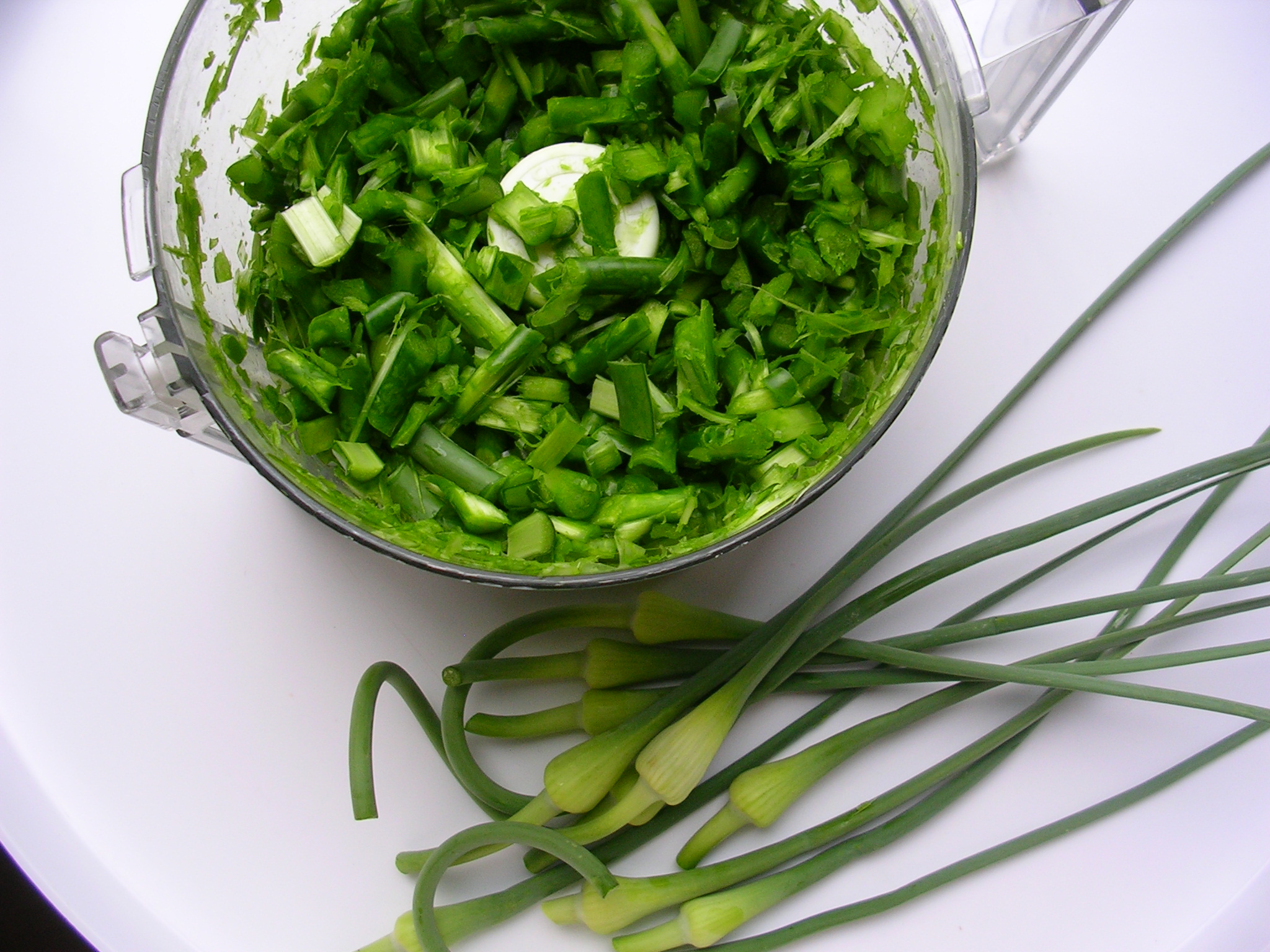
The garlic scapes are in urgent need of cutting so I decided to tinker with a simple and easy formula that uses lots of scapes and thickens the soup by adding a potato. For this recipe it does not matter that some of the scapes are already turning fibrous, as they are only used to infuse the broth and discarded afterwards.

I must admit I was too deliberate with the cayenne pepper so the soup was slightly hot but otherwise I will make it again just like  this – as long as there are still scapes to be cut in the garden.

Cream of Scape Soup

12 scapes, blossom ends removed

3 cups good-quality chicken broth

1 small bunch fresh thyme sprigs

1 medium to large potato, peeled and cubed

1 cup half and half

Salt

Pepper

Pinch cayenne

White wine vinegar

Croutons to serve

1. Cut the scapes into 2-inch chunks and chop coarsely in the food processor.

2. Put chopped scapes in a large saucepan with 2 cups of the chicken broth and the thyme. Bring to a boil, then cover and simmer for 10 minutes.

3. Strain through a fine sieve, reserving the broth. Discard the solids.

4. Pour the broth back in the pan and add the potato and the remaining stock. Bring to a boil, cover, and cook until the potato is soft, 10 to 12 minutes.

5. Puree to a very smooth consistency. Add the cream and reheat. Season with salt, pepper, cayenne, and a dash of white wine vinegar. Serve with croutons.

Makes 4 servings

Strawberry mission accomplished

Finally, after taking all sorts of measures to protect strawberries against critters, there are enough strawberries from the garden to make Rote Grütze, the German red berry dessert that was my favorite as a child. The recipe can be found in my cookbook Spoonfuls of Germany.

Rote Grütze can be served with vanilla sauce, vanilla ice cream, whipped cream, liquid heavy cream, or plain milk. My favorite has always been vanilla sauce made from scratch – lots of it, therefore I often double the amounts.


Scapes straight to the table

“You mean I could have actually made money with these instead of throwing them on the compost?” asked our neighbor last year when I told him about garlic scapes being sold at upscale farmer’s markets. His family has farmed the land for generations, long before organic farming, CSA, slow food, locavore, and all the other wholesome and eco-conscious food trends came about.

His father gave me valuable gardening advice that sounded like it was coming straight from the Farmer’s Almanac, such as “Don’t plant tomatoes before the full moon in May.”  I think he got a kick out of seeing that city girl getting into gardening, and he surely wondered whether I would ever harvest anything. He passed away before my garden really started to thrive but his wife was still around then. She was confined to a wheelchair and spent the most part of every summer day on her porch, from where she waved to me when I passed by on my bike on the way to the post office.

Knowing how much she loved watermelon, I promised her a share of my first watermelon. When it was finally ripe, my husband phoned her to tell her he would bring it over but said he wanted to alert her it was so big that he had to take the truck. After that day, until she died, every time I stopped on my bike for a quick chat, she raved about how sweet that watermelon had been, then drifted off into an endless chuckle about the truck being needed to deliver it.

Back to scapes. Last year, I made scape pesto and scape butter. Both were good but I found that after a few days, the garlic flavor becomes too pungent and overpowering. I think it is best to eat scapes within a couple of days. So now I am picking not more than 2 to 3 scapes at once to make only a small amount of a dish. Unlike most days, the goal is: no leftovers.

Scape Topping for Pasta

2 to 3 scapes

½ to ¾ cup extra-virgin olive oil

Salt

Freshly ground black pepper

Freshly grated Parmesan

1. Cut the pointy tips off the scapes and discard. Finely chop the scapes.

2. Slowly warm the olive oil in a small saucepan. The oil should not be hot so the scapes won’t sizzle when you add them. Remove from the heat and stir in the scapes. Let sit for a few minutes, then season with salt and pepper. Serve over whole-wheat spaghetti with plenty of Parmesan.

Makes 2 servings

Feta Cheese Balls with Scapes and Hazelnuts

2 to 3 scapes

15 whole hazelnuts

8 ounces feta cheese

Extra-virgin olive oil

Freshly ground black pepper

1. Cut the pointy tips off the scapes and discard. Slice the scapes very thinly.

2. Lightly toast the hazelnuts. Set aside to cool. Rub off most of the skins and discard. Chop the hazelnuts coarsely.

3. Process the feta in a food processor to a very fine crumble. With slightly damp hands, form six compact cheese balls of the same size.

4. Pour a small amount of olive oil on a plate. Mix the scape slices and the hazelnuts with freshly ground pepper on another large plate.

5. Roll the cheese balls first in olive oil to coat lightly, then in the scape and hazelnut mix, pressing it gently into the cheese. Cover with plastic foil and refrigerate until serving.

Makes 3 servings