Dumping ground for green peppers

The weather forecast of the first patchy frost tonight drove me out of bed early to bring in the last of the tender crops, peppers and basil.

There are not too many peppers left on the plants but they are big this year. I weighed an especially large one they other day: almost 14.5 ounces (405 grams).

To ripen green peppers it is usually recommended to place them in a paper bag with an apple, which gives off ethylene and should help turning the peppers red. Yet I have found that the apple does not do much to speed up the process. Most of the peppers turn soft before turning red.

Green bell peppers are my least favorite of all peppers but there is one recipe for which I need them, that’s why I always freeze some. My husband and I once ate a black bean soup with cilantro at a local restaurant and both liked it so much that I tried to recreate it at home. It has become my standard recipe for black bean soup.

Black Bean Soup with Cilantro

This soup is made with dried black beans that need to be soaked beforehand. I do not recommend using canned beans, not only because I am a make-from-scratch proponent – the beans need to absorb the flavors as they cook.

2 tablespoons olive oil

1 large onion

½ celery stalk, diced

½ carrot, diced

1 large green bell pepper, seeded and diced

2 bay leaves

2 teaspoons chopped fresh rosemary, or 1 teaspoon dried

1 teaspoon dried thyme

1½ cups black beans, soaked for 8 hours or overnight

1 tablespoon tomato paste

1 small bunch fresh cilantro, leaves only

Salt

½ cup dry sherry

Heavy cream or milk (optional)

1. Heat the olive oil in a large pot. Add the onion and cook until translucent, then add all the vegetables and the herbs. Cook about 8 minutes until the vegetables soften, stirring. Add the tomato paste and stirring until mixed in well. Drain the beans and add them with 5 cups water.

2. Bring to a boil, then reduce the heat and cover. Simmer covered for 1 hour, stirring once in a while. Add salt and cook for another 30 minutes.

3. Remove the bay leaves. Coarsely chop the cilantro leaves and add them to the soup. Puree the soup with a stick blender, or in small batches in a blender. Bring back to a simmer and add the sherry. If the soup is too thick, add water. Salt to taste and stir in few tablespoons heavy cream if desired.

Makes 6 servings

Squirrel with a chest freezer

At this point I am sick and tired of canning, blanching and freezing, and cleaning the kitchen afterwards. There is still a good amount of crops in the garden: lettuce, arugula, beets, spinach, radishes, kale, collard greens, and carrots, not to forget the jalapeño plant, almost a bush by now that just won’t stop producing. Yet most of the fall harvest will not require lengthy and messy processing.

The sight of the filled freezer and the line-up of jars with jam, jelly, chutney, relish and other preserves is utterly satisfying. Like a squirrel, I have packed away as much as I can for the winter. Thanks to the generator we finally installed, this is the first year I don’t have to worry about spoilage any longer when we are without power for days in a row, like last year after Hurricane Irene in August and again after a foot of snow in late October.

With the gardening season winding down, I have time for another fall project: the revised edition of Spoonfuls of Germany, my German regional cookbook (see my new blog).

It’s funny though, as much as I welcome the upcoming downtime, I already find myself thinking about the elderberries that need to be moved in the spring, about which new crops I want to try next year, and how I can find a rhubarb forcer in the United States. As a gardener, even when you don’t stick your hands in the dirt, your head is somehow always in it.

Cherry Tomato Cobbler

Two new tomato dishes I tried this year are definite keepers: Sarah Leah Chase’s Scalloped Tomatoes (with olive oil, not bacon; a food52 Genius recipe), and this Cherry Tomato Cobbler. There are several recipes for tomato cobbler recipes out there but they all call for all-purpose flour only. That would have tasted too much like a regular sweet cobbler to me, tomatoes need something more rustic so I used a mix of cornmeal and all-purpose flour for the topping.

This is a great way to use all those not-so-pretty cherry and/or grape tomatoes, as well as the end-of-the-season runt right now. To avoid a soupy consistency, I added extra cornmeal to the tomatoes.

In the summer I made the cobbler in a large gratin dish but I thought it would be also nice to give everyone their individual serving dishes. I don’t own ramequins so I used ovenproof French onion soup bowls. They turned out to be perfect – shallow ramequins would have been too small.

Filling:

2 tablespoons olive oil

1 large red onion, thinly sliced

2 large garlic cloves, pushed through garlic press

1 tablespoon dried oregano

2 pounds cherry or grape tomatoes

3 tablespoons cornmeal

1½ teaspoons kosher salt

Freshly ground black pepper

Cobbler topping:

1 cup all-purpose flour

1 cup stoneground cornmeal

2 teaspoons baking powder

½ teaspoon salt

4 tablespoons cold butter, cut into small cubes

¾ cup heavy cream

1. Heat 2 tablespoons oil in a skillet and cook the onion until soft and starting to brown at the edges, about 10 minutes, stirring often. In the last 2 minutes, add the garlic and oregano. Remove from the heat and season with salt and pepper. Set aside to cool.

2. Preheat the oven to 375 degrees F.

3. In a large bowl, combine the tomatoes, cooled onions with herbs, cornmeal, kosher salt and pepper.

4. For the cobbler topping mix flour, cornmeal, baking powder, and salt in a bowl. Work in the butter with a pastry cutter or with your fingertips. Once is has a crumbly consistently, add the cream and fold it in swiftly with a fork; do not overmix.

4.  Divide the tomato filling among 6 ovenproof French onion soup bowls, or put it all in one large gratin dish. Top with the cornmeal crumbles.

5. If using individual serving dishes, place them on a jelly roll pan to catch any drips. Bake in the preheated oven for 40 to 45 minutes, until the tomatoes are bubbly and the tops golden brown. Serve hot or lukewarm.

Makes 6 servings

Gigantic, pretty and quite controversial

No wonder the storm knocked over one of my Jerusalem artichoke plants – they are more than 9 feet (3 meters) high. The plant was beyond rescue so I pulled it but I staked and tied the others because it is too early to harvest Jerusalem artichokes. The tubers should be dug after frost, which makes them sweeter, but before the ground freezes.

Because the plants are so tall I did not realize they are covered with yellow flowers at the top that look like small sunflowers; in fact, Jerusalem artichokes are a member of the sunflower family. So I got some benefit out of the lost plant after all: a big beautiful bouquet for the dining table.

Jerusalem artichokes are one of the most controversial vegetables. Some people love them and are ready to pay a hefty price. I have seen organic Jerusalem artichokes for more than $5 per pound. Others plainly and simply hate them, mainly because they can cause intestinal gas. The most outspoken condemnation is from an early 17th-century popular botany book, Gerard’s Herbal, where Jerusalem artichokes are called “more fit for swine than men.” If harvested after frost, the inulin (the dietary fiber that is the culprit for causing gas), is significantly reduced. Also, cooking Jerusalem artichokes at high heat, like in my Jerusalem artichoke salad, and not eating them raw makes them easier to digest.

The gardening tips for growing Jerusalem artichokes are just as divided. Some sources warn you that they will take over your garden and you will deeply regret plating them. Others tell you to remove the flower buds so the tubers grow bigger. Go figure.

I am taking the middle route, trying to thoroughly dig out all the tubers so they won’t spread into unwanted areas. And, I leave the flowers on. They are pretty and I would not haul a ladder into the herb garden to reach them anyway. And, if the Jerusalem artichokes ever take over I shall maybe consider getting a pig. Pigs love Jerusalem artichokes and can locate the tubers in the soil. Just like truffles! With the exception that the pigs dig the tubers up and eat them, which takes care of the tubers spreading.

On a second thought I am not sure a pig would be such a good idea, it will likely dig up the rest of the herb garden, too…

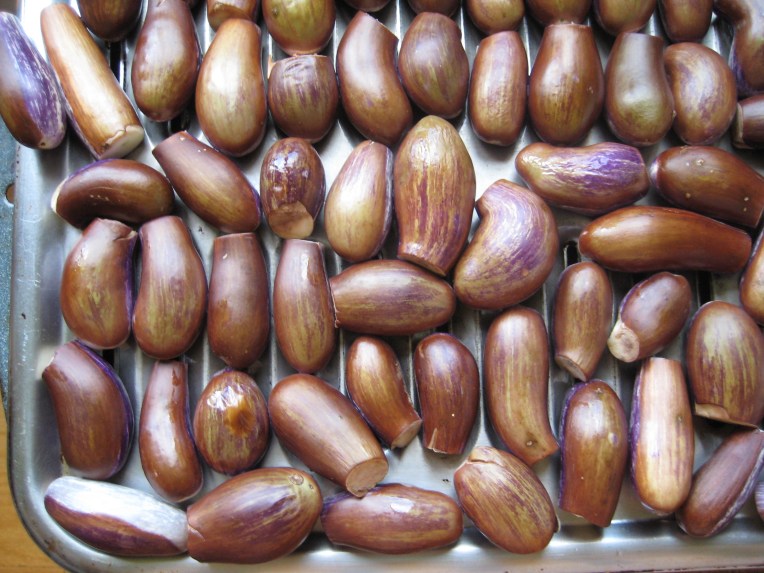
No eggplant left behind

As the nights are getting chilly, the skin of the delicious Fairytale eggplants toughens. A few days ago the eggplants melted in your mouth. Now you can still eat them whole, and they are still good, but they are not at their peak any more.

I picked my six plants clean and used the larger ones for a dip adapted from Deborah Madison’s excellent Roasted Eggplant Dip with Dill, Yogurt, and Walnuts, which I like better than traditional Baba Ghannoush with tahini. As eggplants and eggplant skins are a good addition to vegetable broth (here is my recipe), that’s where all the other tiny eggplants are going.

Not a single eggplant left. I will for sure grow those again next year!

Fairytale Eggplant Dip with Dill

Adapted from Vegetarian Cooking for Everyone by Deborah Madison

There is more waste from all the skins of the small Fairytale eggplants, therefore I started with a full 2 pounds of eggplant instead of the 1 1/4 pounds in the original recipe. Also, I always throw in a handful of dill fronds (all tough thick sprigs removed) instead of chopping the dill, as everything gets finely pureed in the food processor anyway.

2 pounds Fairytale eggplants

Olive oil

1/3 cup walnuts

3 garlic gloves

1 handful of fresh dill fronds

3 tablespoons extra-virgin olive oil, more for pouring onto the dip

1/2 cup Greek yogurt (I used 0%)

Salt

Freshly milled black pepper1. Preheat the oven broiler and set the rack about 5 inches from the heat.

2. Cut the blossom ends off the eggplants. Put the eggplants in a large bowl and toss them with a little olive oil to coat evenly. Distribute them evenly in one layer on a roasting pan and place them under the broiler. Stand by closely, they turn brown very quickly. Once the tops have slightly charred, turn them and broil from the other side. Test one eggplant to check if the skin can be easily removed; if not, let the skins char some more, turning the eggplants as needed. Remove from the oven and cool slightly.

3. As soon as the eggplants are cool enough to handle, remove the skins. The easiest way to do this is by making an incision along the length of each eggplant and flap it open. Collect the pulp in a bowl and set aside to cool.

4. Lightly toast the walnuts in an non-greased pan. Let cool, then place it in the food processor, together with the eggplant pulp and all the other ingredients. Puree to a fine consistency and salt and pepper to taste. Alternatively, you can also puree the dip with a stick blender if the bowl is large enough to hold all the ingredients. Scoop the dip into a container with a tight-fitting lid and pour a little extra-virgin olive oil on top to prevent it from drying out. Refrigerate. Serve at room temperature, stirring well to smoothen before serving. The dip keeps in the refrigerator for 4 to 5 days.