Apricot tart, juicy and impromptu

My baking is often quite unorthodox. I start with a recipe, then change course mid-way, hoping it will work out. This time I had a basket full of beautiful, super-ripe apricots from a local orchard sitting on the counter. The apricots were so juicy that I feared the crust would turn soggy if I placed the apricots directly on the dough. So I turned the recipe upside down. I sprinkled the dough with the sugar-almond mix that was supposed to go on top, and made another batch of the almond-sugar mix for the topping. In fact the apricots were so juicy that as an additional precaution, I placed a jelly roll pan on the rack underneath to catch any drippings, and I am glad I did.

I took notes just in case the apricot tart would turn out fine. It did! Here is the recipe:

Apricot Tart:

Crust:

1 1/3 cups flour

1 stick chilled unsalted butter, cut into chunks

1/3 cup + 1 tablespoon sugar

Pinch of salt

1 egg yolk

Topping:

1/3 cup whole unpeeled almonds

1/3 cup sugar

4 tablespoons apricot preserves

1.5 pound ripe apricots

1. Place the flour and the butter in the food processor and process to a crumbly consistency. Add the sugar, salt and egg yolk and process until the dough forms a ball. Put the dough in a container with a lid or in plastic wrap and place in the freezer for 20 minutes.

2. Toast the almonds in an ungreased pan. Cool, then grind in the food processor with 1/3 cup sugar.

3. Butter a 9-inch tart pan (I used one with a removable bottom) and sprinkle with 1 tablespoon of the almond mix.

4. Preheat the oven to 400 degrees F.

5. Roll out the dough between two pieces of wax paper to a 11-inch circle. Fit the dough into the tart pan with the dough coming up the sides. Trim extra dough with a knife or gently even it out by pinching it together with your fingertips. Sprinkle with half of the remaining almond mix.

6. Wash the apricots and dry well. Cut in half and remove the pits. Place the apricots on the dough cut-side down; they should fit snugly.

7. Warm the apricot preserves and strain them through a fine sieve and brush the apricots with it. Sprinkle with the remaining almond mix and bake in the preheated oven for 40 minutes, or until the crust is golden. Let cool on a wire rack.
Know no shame, or: Anything for strawberries

Even after ten years in the country, I am squeamish as can be about anything furry – dead, alive, or in-between. Once our dog killed a groundhog in front of the garage door and it remained there until my husband returned from a trip to his parents a couple of days later. My mother-in-law, on one of my hysterical phone calls, recommended to cover it with an old towel, then load it onto a shovel, but just approaching the thing sent me screaming.

When it comes to protecting the new strawberry patch, however, I seem to be turning into a fearless, indelicate roughneck. The new commercial repellent I spread around the patch about a week ago seems to be working. But when I was weeding down there the other day and saw our dog lift his leg a few times around the patch, I had an idea. I had read somewhere that fermented human urine works as a critter repellent. Since we won’t be eating strawberries from the patch until next summer, and urine is sterile anyway, why not collect our own organic repellent? I sprinkled an old lemonade bottle full of donations around the perimeter of the patch twice this week. No rabbit damage so far!

But the next worry is already lurking around the corner. When I bought strawberries from our neighbor yesterday, he complained about half of his patch being affected by fungus because he had sprayed only once this season. Of course, now I am wondering what else will I have to battle after the rabbit plague, especially because I want to grow the strawberries organically, like the rest of the garden.

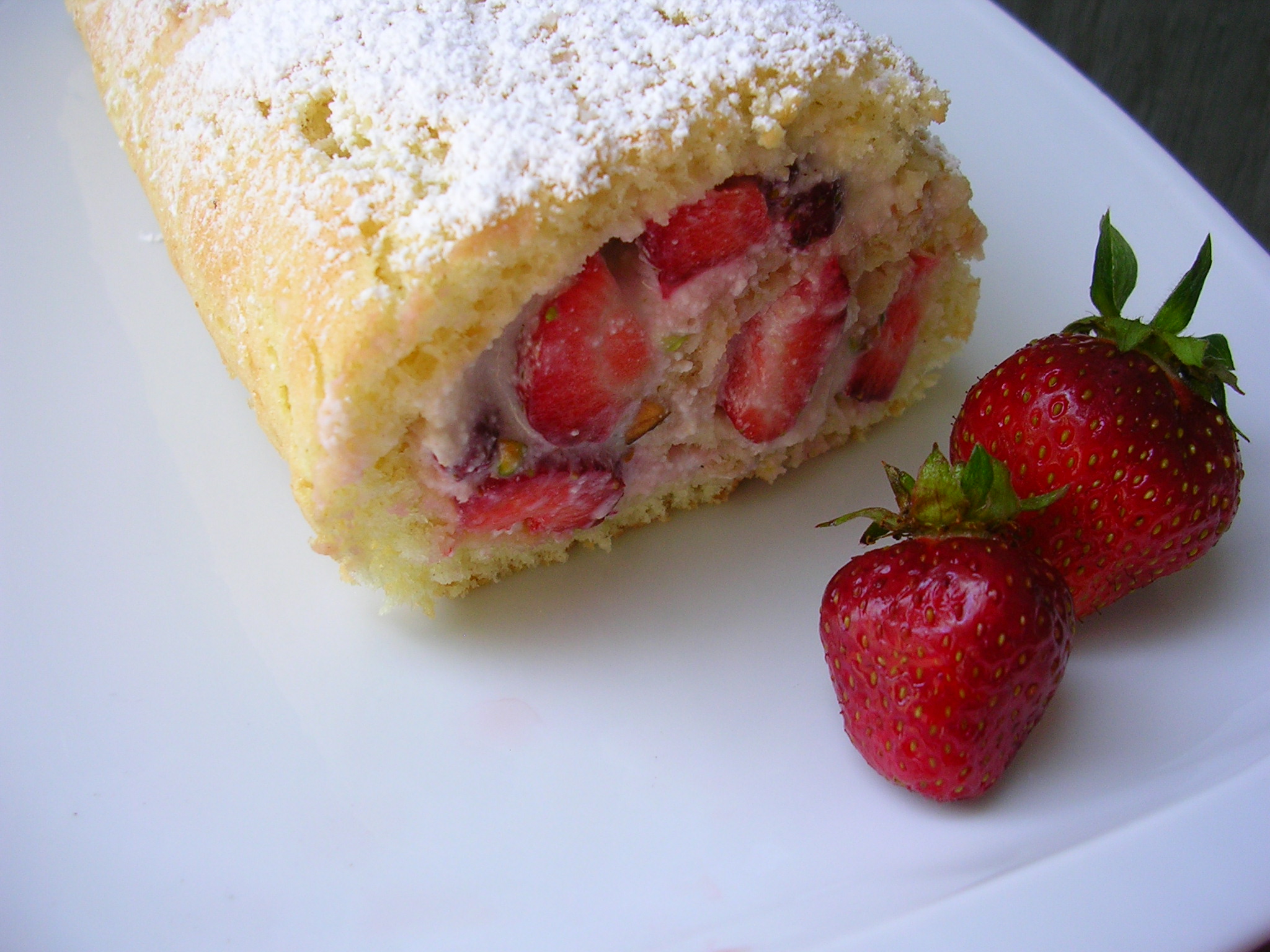
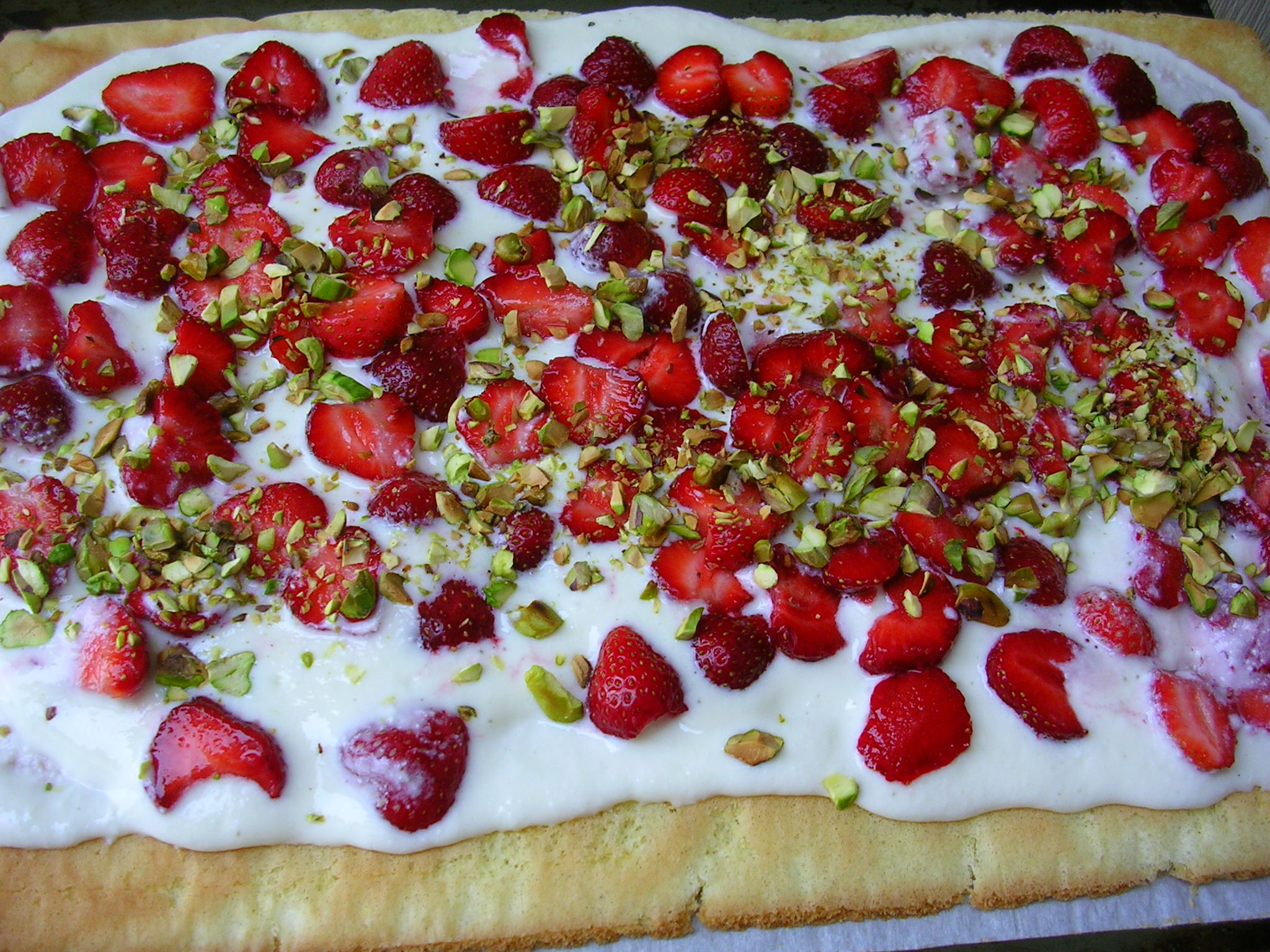
Enough kvetching, let’s get to the bright side of strawberries. Thanks to the healthy half of our neighbor’s strawberry patch, I was able to make another strawberry cake. It had to be something really easy and quick with the ingredients I had in the house, which was low-fat ricotta, but certainly whole-milk ricotta will make an even better, creamier filling.

Strawberry-Ricotta Roulade with Pistachios

Sponge cake:

2 eggs + 1 egg white

½ cup sugar

¾ cup flour

1 teaspoon baking powder

1/8 teaspoon salt

Filling:

¼ cup shelled pistachios

12 ounces strawberries

10 ounces ricotta

2 teaspoons vanilla extract

½ cup confectioner’s sugar, more for dusting

1. Preheat the oven to 400 degrees F. Line the bottom of a 16 x 11-inch jellyroll pan with parchment. Grease the parchment and the sides of the pan.

2. Beat the eggs and the egg white until light and fluffy.

3. Mix the flour with the baking powder and the salt and sift into the eggs. Fold it into the eggs lightly but thoroughly until no more flour pockets remain.

4. Pour the dough into the jellyroll pan and smoothen it with a spatula.

5. Bake in the preheated oven for 10 minutes, or until golden and springy to the touch.

6. Lift the parchment with the sponge cake onto the kitchen counter or a baking sheet and cover immediately with a clean dry kitchen towel. Let cool.

7. Lightly toast the pistachios. Cool, then chop and set aside.

8. Beat the ricotta with the vanilla extract and the confectioner’s sugar until smooth and creamy.

9. Wash, hull and slice the strawberries.

10. Flip the parchment with the sponge cake over and place it on a large baking sheet lined with the kitchen towel or with parchment. Carefully remove the parchment from the baking of the sponge cake.

11. Spread the ricotta evenly over the sponge cake, leaving about ½ inch uncovered on the long sides. Spread the sliced strawberries on top and sprinkle with the pistachios.

12. Using the towel as a lifter, roll up the cake from the long side. Place the roulade with the seam-side down on a serving platter. If you are making this just en famille, and not for fancy presentation, or if you don’t. have a platter long enough, cut it in half to fit, (that’s what I did). Chill for 1 hour. Dust with confectioner’s sugar before serving.

The spirit is willing but…

It’s true, I just recently made the resolution not to buy any more kitchen tools. Easier said than done – when I was in an overstuffed kitchen supply store in New York this week, I succumbed to the temptation. No matter how much my friend teased me, saying I did not need this ludicrous “beginner’s tool”, I bought an egg separator ($1.91 including tax, so money-wise it was a modest impulse purchase). And, I must say it came very handy for the eight eggs that went into the almond-orange cake for a Passover Seder.

I started out with Claudia Roden’s recipe for Almond Cake in Orange Syrup from The Book of Jewish Food but ended up combining and tweaking several of her recipes. Because the cake had to travel several hours to its destination, I assembled it on site. Next time I will definitely use a springform pan, which is higher than the cake pan I used. My cake baked over the rim and crumbled, but since it is sitting in syrup anyway, the imperfection could be disguised by flipping the “ugly” side to the bottom.

Almond Cake with Oranges

Oranges in syrup:

4 large oranges, at least two of them organic

3 cups sugar

Juice of 1 lemon

Cake:

7 ounces unpeeled raw almonds

8 eggs, separated

1 cup sugar

2 teaspoons cinnamon

2 cups orange juice (can be store-bought, but use a good quality)

2 tablespoons orange liqueur (Cointreau)

1. For the oranges in syrup, scrub the two organic oranges with a brush under running water. Dry and zest them thinly. Peel the other two oranges. Thoroughly remove the white pith from all the oranges.

2. Cut the oranges into even 1-inch slices and remove any seeds and pith from the middle.

3. Bring 4 cups water, the sugar and lemon juice to a boil in a large skillet. Stir until the sugar has dissolved.

4. Carefully place the orange slices in the skillet, if possible in a single layer. Put an inverted dinner place on top to fully immerse the slices in the liquid. Cover and simmer for 1 hour.

5. Remove the oranges from the liquid with a slotted spoon. Spread them in one layer on a large plate.

6. Boil down the syrup at high heat to about half. Let cool.

7. Place the almonds in a heatproof bowl and cover with boiling water. Let stand for 5 minutes, then drain and fill the bowl with cold water. Slip the almonds out of their skins and spread them on paper towels to dry.

8. Grind half of the almonds finely in the food processor. Chop the other half of the almonds to a coarser but not chunky consistency, using the pulse function.

9. Preheat the oven to 350 degrees F. Grease a 10-inch springform pan.

Chop the orange zest very finely.

10. Separate the eggs. Beat the egg yolks with the sugar, cinnamon, and almonds. Beat the egg whites until stiff and fold them into the batter.

11. Pour the batter into the prepared pan and bake in a preheated oven for 1 hour, or until a toothpick comes out clean. If the cake browns too much but is not done yet, cover it loosely with aluminum foil.

12. Let cool slightly, then carefully remove from the pan and cool completely on a cake rack.

13. Boil the orange juice down to about half. Let cool and stir in the Cointreau.

14. A couple of hours before serving, place the cake on a deep cake plate. Pierce the cake several times with a fork. Drizzle with half of the reduced orange juice.  Arrange the orange slices on top and brush them with a bit of the syrup for a glaze. Pour the rest of the reduced orange juice all around the cake and chill until serving.

A substitute for Quark

Until Greek yogurt become more widely available in the United States in recent years, as a native German I felt extremely Quark-deprived. Creamy Quark, which is often referred to as cottage cheese without curds but is actually nothing like it, is my favorite dairy product. It can be made at home (the recipe is in my cookbook Spoonfuls of Germany), however, the process is lengthy and quite involved, and getting the right consistency is a hit and miss.

Greek yogurt is an acceptable substitute for desserts calling for quark, and other non-baking recipes. For cakes and pies, however, I find it rather flat. But don’t get me wrong, I am already quite happy to be able to make desserts that taste almost like Quark.

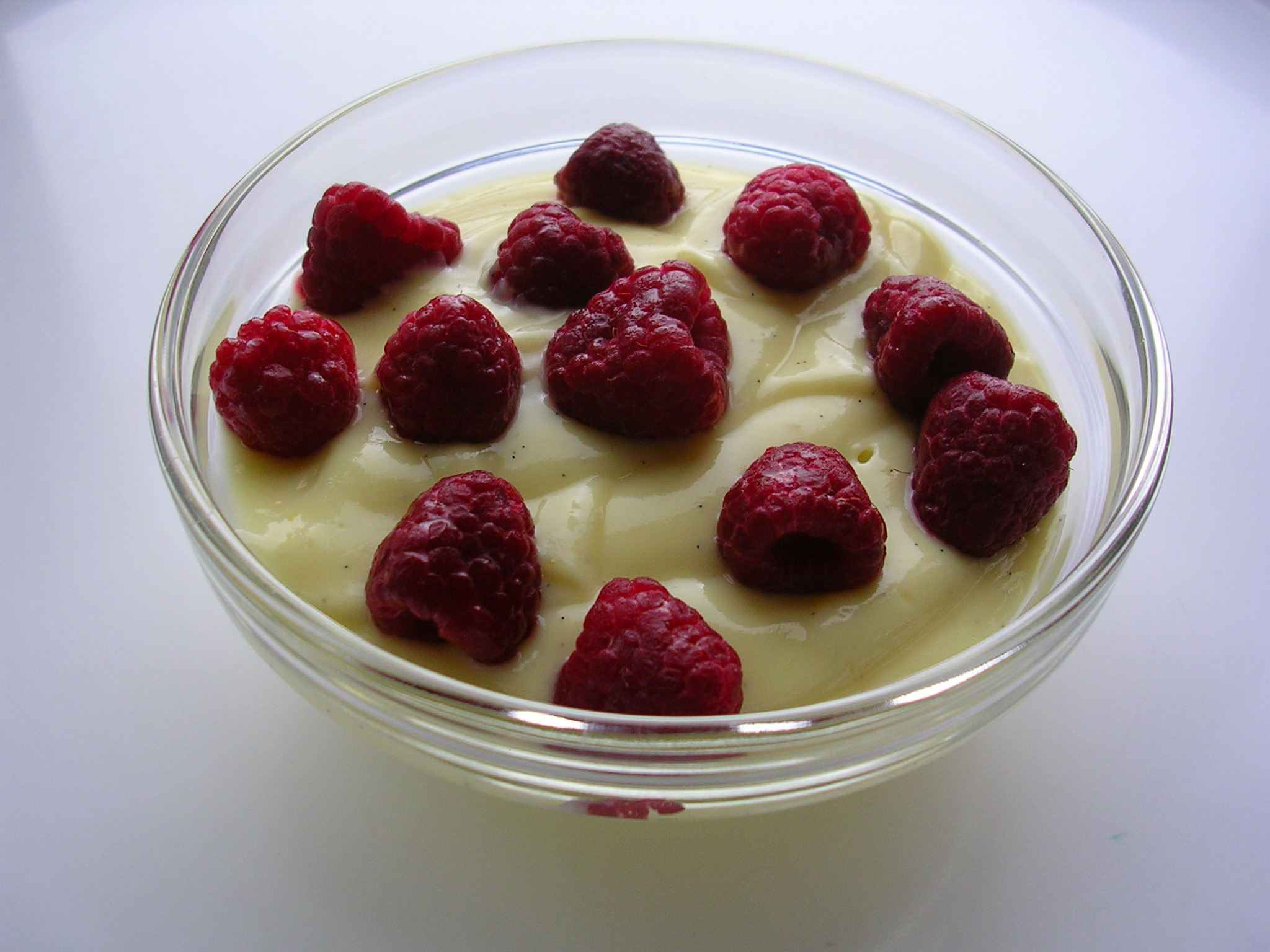
When I was a kid my mother used to make this vanilla custard with Quark, which I could eat by the tubful. She used instant custard powder while I make the custard from scratch. I topped it with our last own frozen raspberries but there is room for experimentation here.

Vanilla Custard with Greek Yogurt

1 cup milk (2%)

1 vanilla bean

3 egg yolks

1 tablespoon cornstarch

2/3 cup sugar

2 cups Greek yogurt

Fruit topping to taste (raspberries, blueberries)

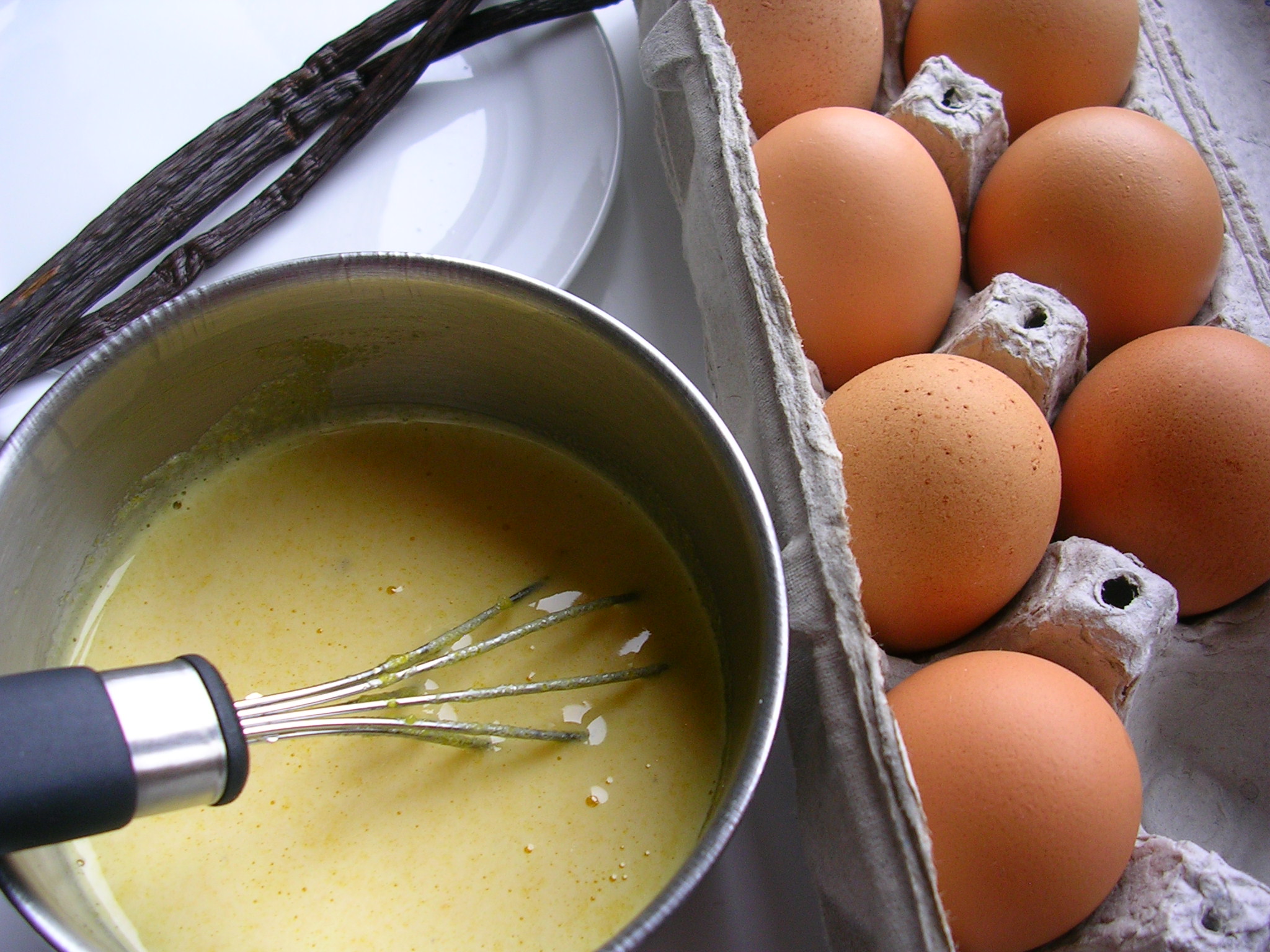
1. Put the milk in a small pot. Split the vanilla bean lengthwise and scrape the seeds thoroughly into the milk. Add the vanilla bean to the milk and slowly bring to a boil.

2. In the meantime, whisk the egg yolks with the cornstarch and the sugar until both are dissolved. There should not be any lumps.

3. Strain the milk and pour it back into the pot. Put it back on the stove and whisk in the egg mixture.

4. Bring to a gentle boil until the custard thickens, whisking constantly. Make sure to also scrape with the whisk over the bottom to prevent the custard from sticking and burning.

5. When the custard is nice and thick, remove from the heat immediately. Let cool completely, stirring every now and then.

6. Add the Greek yogurt and whisk until creamy. Refrigerate. Top with berries or other fruit to taste.