All the whey

Compared to one-third of all food that is being wasted worldwide, cringing over throwing out a heel of home-baked bread because it turned moldy might seem puny. Yet I found myself thinking of ways how I can prevent this from happening again. Yes, I am sort of a relentless food saver. Therefore I of course had to do something with the gallon of whey that I brought back from the instructional and fun mozzarella-making potluck at phoebe’s pure food last weekend.
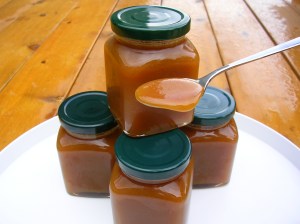
I wanted to make dulce de leche. When looking for a recipe I found a booklet entitled, “Uses of Whey in the Farmstead Setting” (love that title!) from the Wisconsin Department of Agriculture. It includes some bizarre ideas such as whey wine, whey beer and whey champagne. Whey, so I learned, can also be used as animal fodder. The booklet only mentions cattle, pigs, sheep and poultry, but when I fed our dog his pills with the curds I had strained from the whey, he slurped it up in seconds.

Using whey and sugar in a ratio 1:2 as the recipe said seemed outrageous. I decided to tinker with it and cook down the whey first to get it more concentrated, then mixed whey and sugar in a ratio 2:1 (that is one-quart of the suggested amount of sugar!) It worked – the result is a dulce de leche as sweet as it should be, but no more.

Now that I have recycled all the whey, the next question is: what in the world will the farmstead do will all that dulce de leche?

Dulce de leche

1 gallon strained whey

7 cups sugar, depending on the amount of reduced whey

1. Simmer the whey in a large, heavy pot, uncovered, for about 2 hours, stirring occasionally. It will curd a bit but don’t worry, the curds will disappear once the mix, after adding sugar, turns a caramel color.

2. Measure the liquid (I had 14 cups) and add half of that amount in sugar. Slowly bring to a simmer again and cook, uncovered, for 4 to 6 hours, or until the color turns caramel and the mixture thickens. Increase the frequency of stirring as the color darkens, and make sure to scrape over the bottom of the pot.

3. Towards the end, watch the cooking process more closely to prevent the mix from turning too dark. Keep in mind that it will solidify as it cools. Just like for jam and jelly, spoon a bit on a plate and see if it is still too runny. The more solid you want the end result, the longer it needs to cook.

4. Let cool slightly in the pot, then fill into sterilized jars. Only screw the lids onto the jars after the content is completely cooled to avoid condensation build-up. Store in the refrigerator for up to 1 month or freeze in plastic containers.

Makes 5 13-ounce jars
The balance sheet of a pie

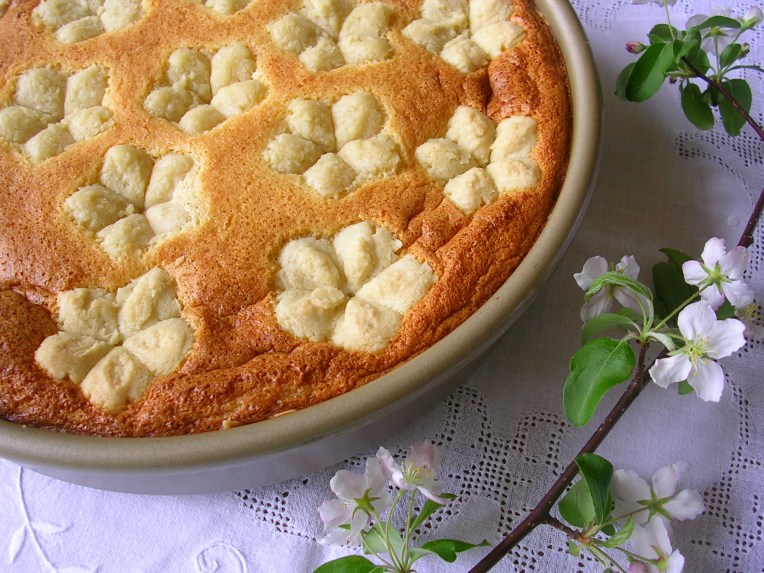
Today I made Ricotta Wheat Pie, a traditional Neapolitan recipe. I had earmarked it a long time ago but never got to it because it seemed quite involved. It was.

Not counting the components of each, I used 16 kitchen tools and gadgets: a pot to cook the wheat berries, a cooking spoon, a small food processor, a blender, two bowls, an egg separator, two spatulas, a small kitchen knife, a pastry roller, a plastic container to chill the dough, a cookie press, a scoop, a jelly roll pan, and a cake pan. Plus two disposables: a sheet each of wax paper and aluminum foil. If the citron and orange peel had not been so dried out, I would have been able to avoid using the blender but only its ice crush function could chop them up. And, if I had had more time, I could have cooled the wheat in the pot instead of spreading it on a jelly roll pan and set it over ice packs to speed up the process. Even discounting those two, it’s a lot of dirty dishes for one pie.Counting the time I spent on this, the gas for the stove, the electricity for the oven, the hot water to wash all those dishes, and… it would have been probably more economical and ecological to drive into town and buy a cake. But it would have certainly not been the type of cake I would want to eat! And, most importantly, I would not have had so much fun (despite the cleaning up). I also finally got the cookie press to work that I bought years ago and, it turned out, I had always screwed together the wrong way.

In 2010, the average American according to The New York Times watched 34 hours of TV every week. That’s baking 8.5 pies like this if you allocate a generous 4 hours active time from start to finish. I rarely watch TV and rather bake.

Seeing the pie cooling on the counter and smelling it all over the house gives me great satisfaction. If it tastes as good as expected and my family likes it, even better.

The recipe is adapted it from Anna Teresa Callen’s My love for Naples.Ricotta Wheat Pie (Pastiera Napoletana di Grano)

Crust:

2 cups flour

¼ cup sugar

1 stick chilled butter, or 4 ounces Land O Lakes butter with canola oil (first time I tried this)

1½ ounces chilled vegetable shortening

1 large egg

Filling:

4 cups wheat berries

1 tablespoon butter

1 untreated lemon

1½ cups milk

½ teaspoon cinnamon

1½ tablespoons + 1 cup sugar

1 pound low-fat ricotta

2 tablespoons orange flower water

2 tablespoons diced citron

1 tablespoon candied orange peel

6 eggs

1. For the crust, put the flour and sugar in a food processor and process to a coarse meal. Add diced butter, shortening and egg and process until the dough forms a ball around the blade. Transfer the dough to a container and refrigerate.

2. For the filling put the wheat berries in a small heavy pot with 4 cups water and the butter. Bring to the boil, then turn down the heat and simmer, covered, for about 2½ hours. Check for water and stir once in a while to make sure it does not cook dry.

3. Drain the wheat berries and return them to the pot. Zest half of the lemon in one large strip and add it to the pot with the milk, the cinnamon and 1½ tablespoons sugar. Bring to the boil, then turn down the heat and cook, uncovered, for 45 minutes until the milk has been completely absorbed. Stir often to make sure it does not scorch, and reduce the heat even further as necessary.

4. Roll out three-quarters of the dough on a sheet of wax paper to fit a greased 10-inch cake pan plus dough to come up almost all the way up the edges. Fit it into the cake pan and even out the edges with a knife. Roll out the rest of the dough and cut narrow strips for a crisscross pattern, or use a cookie cutter / cookie press to cut out shapes to your liking. Place them on a plate lined with the wax paper and put everything in the freezer.5. Remove the lemon peel from the wheat berries and let cool.
6. Preheat the oven to 350 degrees F.

7. Finely zest the rest of the lemon. Put it in the food processor together with the orange flower water, diced citron, orange peel, 1 cup sugar and ricotta and process until the citron and orange peel are finely chopped.

8. Separate the eggs and add the egg yolks to the mix. Beat the egg whites until stiff.

9. Mix the cooled wheat berries with the ricotta mix. Fold in the stiff egg whites. Pour the filling into the prepared crust.

10. Bake in the preheated oven for 20 minutes. After this time, the filling should be set enough to the top crust won’t sink. Carefully remove the cake pan from the oven. Place the cutouts or dough strips on the surface in a decorative pattern and return the cake pan to the oven.

11. Bake for another 55 minutes, or until the filling is set and the top is golden brown. If the top darkens too much, loosely place a greased sheet of aluminum foil on top. Remove the pie from the oven and cool on a cake rack.


The party goes on

Taking red currants out of the freezer for Red Currant Meringue Pie on January 1 is one of the great pleasures of being a gardener. The moment when I poured the frozen pearl-like red currants out of the bag, all the hard work of getting them into that bag was forgotten, although last year was not a good season for currants. I had less than two pounds, which makes today’s pie even more precious. The recipe can be found in my cookbook Spoonfuls of Germany.

While I dread the long, cold winter on our mountaintop in northeast Pennsylvania, I do not wish to live in a place where gardening is possible year round. Each time I wash store-bought lettuce, I think how wonderful it will be to have our own tender greens again in the spring. I would not want to trade the physical and mental 5-month break from gardening, and my looking forward to the new gardening season, for a non-stop crop of lettuce.

Gardening is like a party, where the anticipation and the preparations are part of the fun. Deciding what to grow is like drawing up the guest list. Making a crop rotation plan is like determining the seating order; just like people, not all plants get along with each other. Selecting and ordering seeds is like planning the menu and going shopping. After all is set up and ready, waiting for the wondrous moment when the seedlings emerge is like waiting for the guests to arrive. When they do, all you can do is make sure they feel comfortable and stay as long as you want them to. Enjoying the harvest, fresh from the garden or months later in frozen or canned form, is an ongoing feast!

Pleading for recipes, and playing with persimmons

Some people pride themselves that they don’t ever cook from recipes. Not me. I rely on recipes, daily and heavily. And that is not only because being a cookbook author and food editor, I feel that the shunning of recipes – viewing them as the crutches of mediocre cooks while real, natural talents cook without – undermines the very foundation of the trade.

Why should I burden my already overcrowded memory with things that others (and mostly pros, or cooks far better than me) have figured out and conveniently written down, such as the amount of baking powder in a cake? Julia Child failed her exam at the Cordon Bleu the first time around because she had not memorized the recipes from the school’s cookbook. There is no need to say anything more about the connection between memory and cooking talent.

Rather than piecing a recipe together from memory, I like to spend my time exploring. The few vegetables still growing in the garden in mid-November – beets, radicchio, kale, and cauliflower – do not require any more work, so one of my Sunday morning luxuries is to explore new recipes and ingredients. Today I tinkered with the persimmons I found at a local farm stand yesterday. Call me a culinary greenie but I have never eaten nor prepared persimmons!

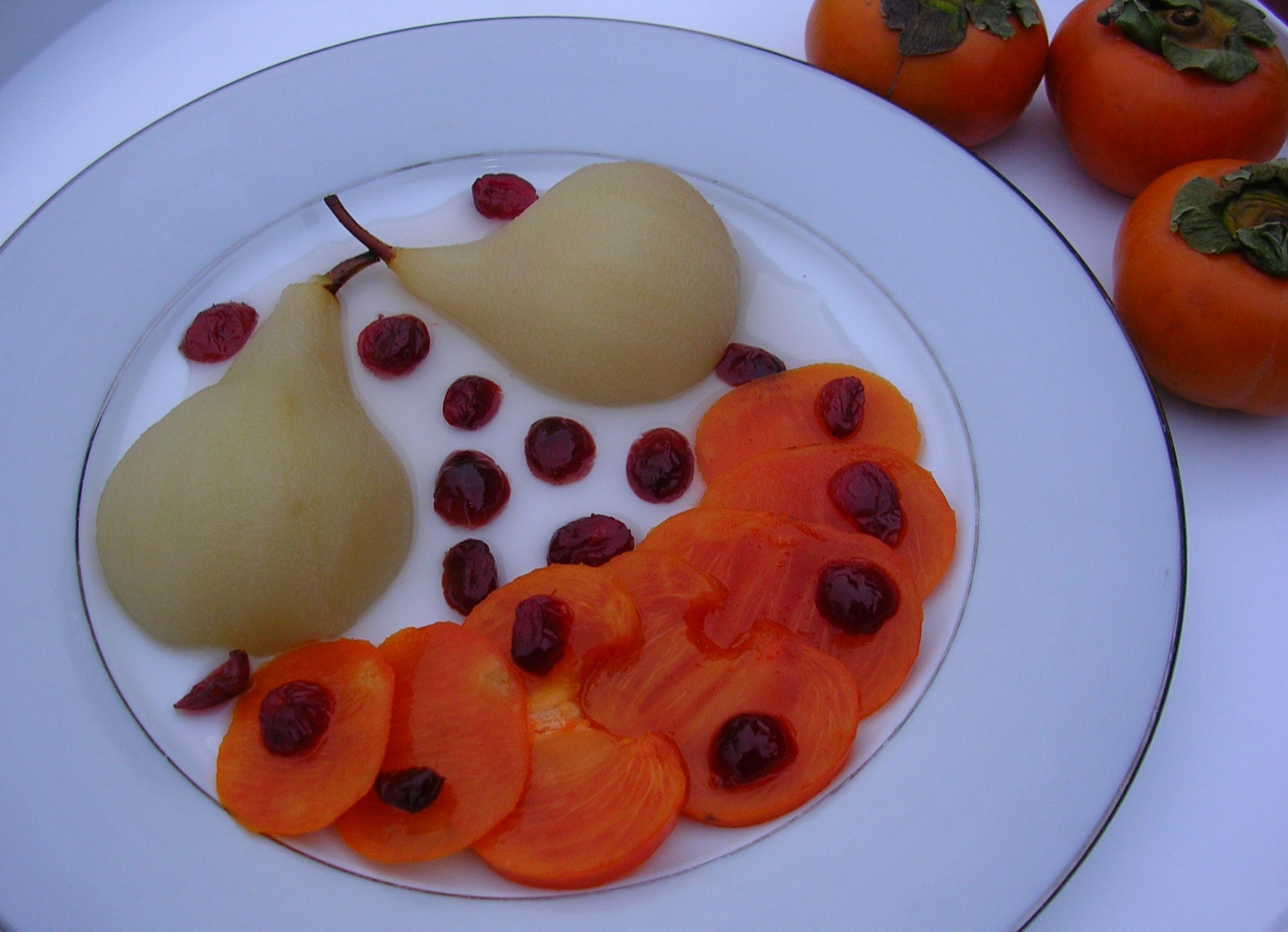
I wanted to leave the persimmons as unaltered as possible. After leafing through cookbooks and surfing the web, I settled on poached pears with persimmons, inspired by a recipe I found in Deborah Madison’s Vegetarian Cooking for Everyone. It is best served chilled.

Poached Pears with Persimmons

1 cup sugar

1-inch piece fresh ginger, peeled and finely sliced

Grated zest of 1 organic lemon

4 firm, slightly underripe Bosc pears

¼ cup dried cranberries

2 ripe Fuji persimmons

1. Bring 1 quart of water to the boil in a wide pot. Add the sugar and stir to dissolve. Add the ginger and lemon zest.

2. Peel, halve, and core the pears. Place them in the simmering water and put a small heatproof plate on top so they are fully immersed in the poaching liquid. Simmer for 20 minutes, or until the pears can be easily pierced with a knife.

3. Transfer the pears to a bowl. Strain the poaching liquid and pour it back in the pot. Bring to a rolling boil and cook for 10 minutes, stirring and scraping the sides often so the syrup does not burn.

4. Stir the cranberries into the hot syrup. Pour over the pears. Cool, then refrigerate.

5. Remove the blossoms ends from the persimmons. Using a serrated knife, cut the persimmons into thin slices. Serve with the sliced pears and cranberries, drizzled with syrup.

Makes 4 servings