Overcoming the green tomato prejudice

Until now I have been heavily prejudiced against green tomatoes. Not that I ever ate a green tomato. When I occasionally had green tomatoes in the garden because a branch broke off, or I ended up with green tomatoes at the end of the season, I would rather throw them on the compost pile than using them for cooking.

Maybe it’s the idea of eating something unripe that put me off. I know fried green tomatoes are a southern specialty but I was never tempted to try them. I am not a health fanatic but when I use artery-clogging ingredients, I prefer do to it when there is no alternative, such as butter in a piecrust. Also, I do not like the idea of buying additional produce in the height of the harvest to make something with green tomatoes.

When I collected a couple of pounds of green tomatoes from the garden this week, I reconsidered. I constantly try new things, so why not give green tomatoes a second chance and make chutney? I browsed recipes online and went through my cookbooks for inspiration. The only condition I set for myself was that I would minimize the purchase of extra ingredients. Since I have jalapeno peppers in the garden right now (also a premiere), and lots of fresh garlic, the only thing I had to buy for this Green Tomato Chutney were apples. All the other ingredients were staples I had in the house.

As the prospective main chutney eater besides me does not like it too spicy, I removed the seeds from the jalapenos. I am glad I did because the chutney is already quite hot as is. For a hotter version, simply include some or all of the seeds.

I don’t think I will ever actually pick green tomatoes but at least I have a simple recipe that I like in case green tomatoes come upon me. I look forward to opening the first jar of chutney and eat it with Indian food this fall or winter.

For now it’s back to fresh red tomatoes.

Green Tomato Chutney

2 to 2¼ pounds green tomatoes

10 garlic cloves

1 large onion

1 large or 2 small tart apples (I used green summer apples)

3 jalapeno peppers

1 1-inch piece fresh ginger

1 tablespoon black peppercorns

1 tablespoon whole allspice

6 cardamom pods

1 pound 6 ounces Turbinado sugar

1 tablespoon salt

1 cup white wine vinegar

3 bay leaves

1 tablespoon yellow mustard seeds

6 whole cloves

1 teaspoon dried orange peel

1 teaspoon finely grated zest from an organic lemon

You also need:

A canning pot, or a very large stockpot

5 half-pint canning jars

5 bands

5 new (unused) lids

1. Remove the core from the tomatoes and cut them into 1-inch dice. Slice the garlic cloves thinly. Chop the onion. Peel the apples and remove the core. Cut the apples into 1-inch dice. Cut the jalapenos in half and remove the seeds. Chop the jalapenos very finely. Wear disposable gloves to do this, or wash hands thoroughly afterwards to avoid skin and eye irritation. Peel and finely chop the ginger.

2. Crush the peppercorns, allspice and cardamom in a mortar.

3. Mix all ingredients in a non-corrosive pot (no aluminum) and mix well. Cover and refrigerate for 8 hours.

4. Slowly bring the mix to a boil. Cook uncovered for 20 minutes. Fill into sterilized canning jars using a slotted spoon, as you don’t want to fill the jars with too much liquid but make sure the chutney is fully immersed. You will have about 1 to 2 cups of cooking liquid left over; discard. Close jars with brand new lids and bands immediately and process in boiling water bath for 10 minutes.

5. Remove from the water onto damp kitchen towels. Let rest 24 hours before storing the jars in a cool place away from the light.

Makes 5 half-pint jars
Are you jellin’?


When I first moved to the United States, I loaded up on all types of baking and cooking ingredients on each visit to my native Germany. Meanwhile I have found decent substitutes for most items, except one: jelling sugar.

In Germany, jelling sugar comes in three variations of fruit-to-sugar ratio, depending on the sweetness of the fruit and personal taste: 1:1, 2:1 and 3:1. It’s a natural product, made from pectin in apples and citrus fruit. And, it comes ready-mixed, or as a jelling powder concentrate to which you add sugar (lightweight and therefore perfect for airline travel). Some online stores specializing in German foods have it but when I inquired at Dr. Oetker USA, I was told they don’t carry it. Too bad, because there is really nothing like it in the US. Many American recipes call for twice as much sugar as fruit.

So don’t hesitate if you can get your hands on imported jelling sugar. Alternatively, you can use pectin products for less sugar or no sugar recipes, to obtain an jam or jelly that actually tastes like the fruit, not just sugary.

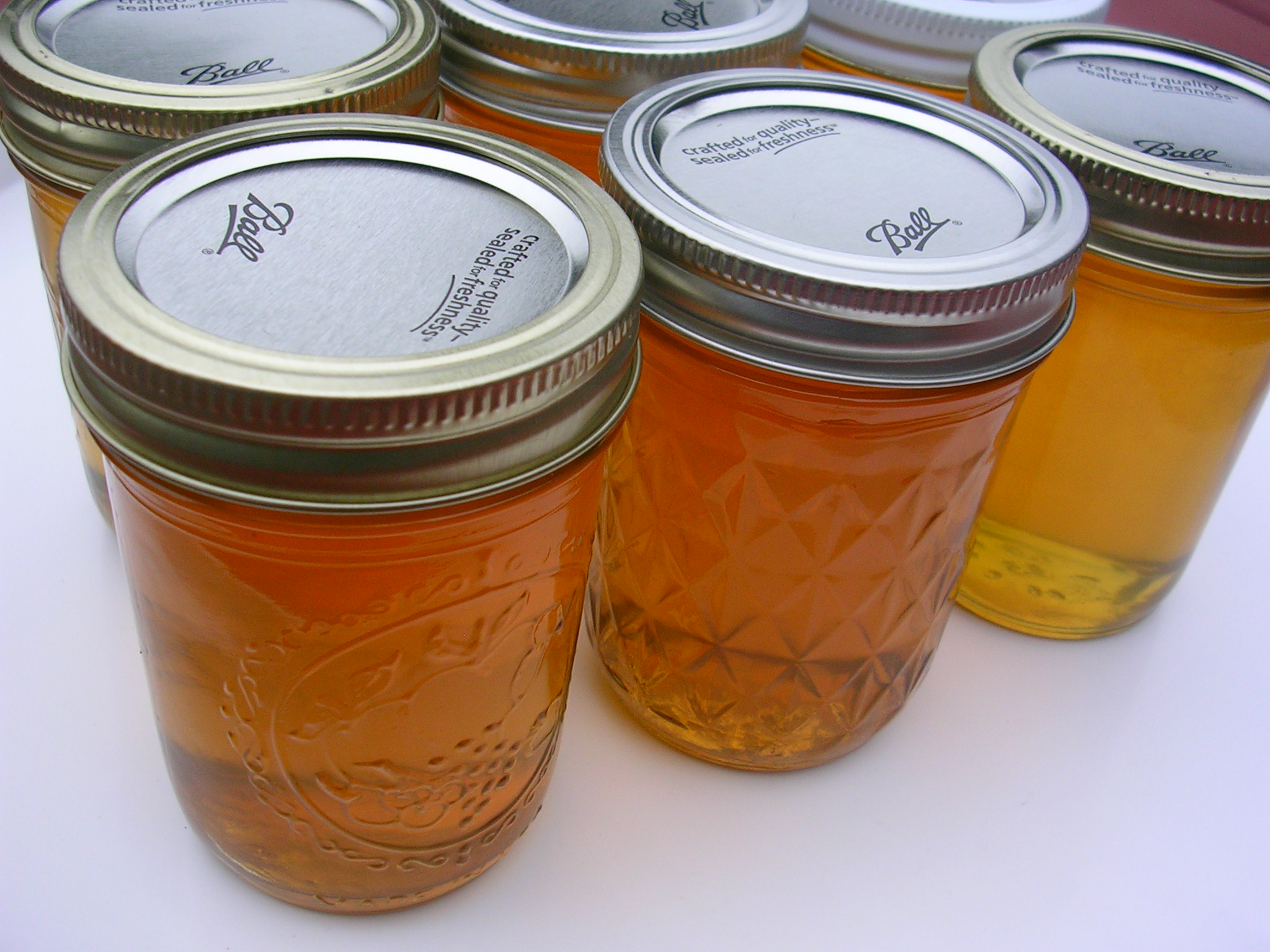
This was the first year I had enough blossoms on my elderberry bushes to dare snipping some off for elderflower jelly. The heavenly scent alone is worth making it. In the past few days I have spotted wild elderberry blooming along the roadside. As long as it’s not in a polluted area, and the plants have not been sprayed with any pesticides, you can use those. To make sure you are really harvesting elderflowers, check out some elderberry images, for example on the website of the Missouri Botanical Garden, which has an excellent plant database.

I might go forage elderflowers myself to try some other elderflower recipes.

Elderflower Jelly

8 cups clear apple juice without artificial coloring or additional sugar

15 to 20 elderberry flowerheads

1 package fruit pectin for less or no sugar recipes

4 cups sugar

You also need:

A canning pot, or a very large stockpot

10 half-pint canning jars

8 bands

8 new (unused) lids

1. Shake the elderflowers to remove any bugs. Remove all the stems.

2. Immerse the flowers in a large bowl filled with cold water. Swish around and place in a colander. Repeat this process once or twice. If there are still tiny insects on the flowers, don’t worry. The juice will be strained and cooked.

3. Place the flowers in a large plastic container with a lid. Pour the apple juice over it. Push down; the flowers should be fully immersed in juice. Cover and refrigerate for 48 hours.

4. Pour the liquid through a fine sieve. Repeat the process. You may also line the sieve with a piece of damp cheesecloth if you are really worried about bugs.

5. Follow the package directions for your pectin product. When the mixture boils, remove any foam with a ladle or a large spoon.

7. Pour the hot jelly in sterilized jars through a canning funnel. Wipe the rim with a damp piece of paper towel to remove any drips and wipe dry with paper towel. Place the lids and the bands on the jars and process in a boiling water bath for 10 minutes.

9. Let cool and set for 24 hours without moving the jars. If processed properly, the jelly will keep for 1 year or more.

Makes 10 half-pint jars

Short-order pickles

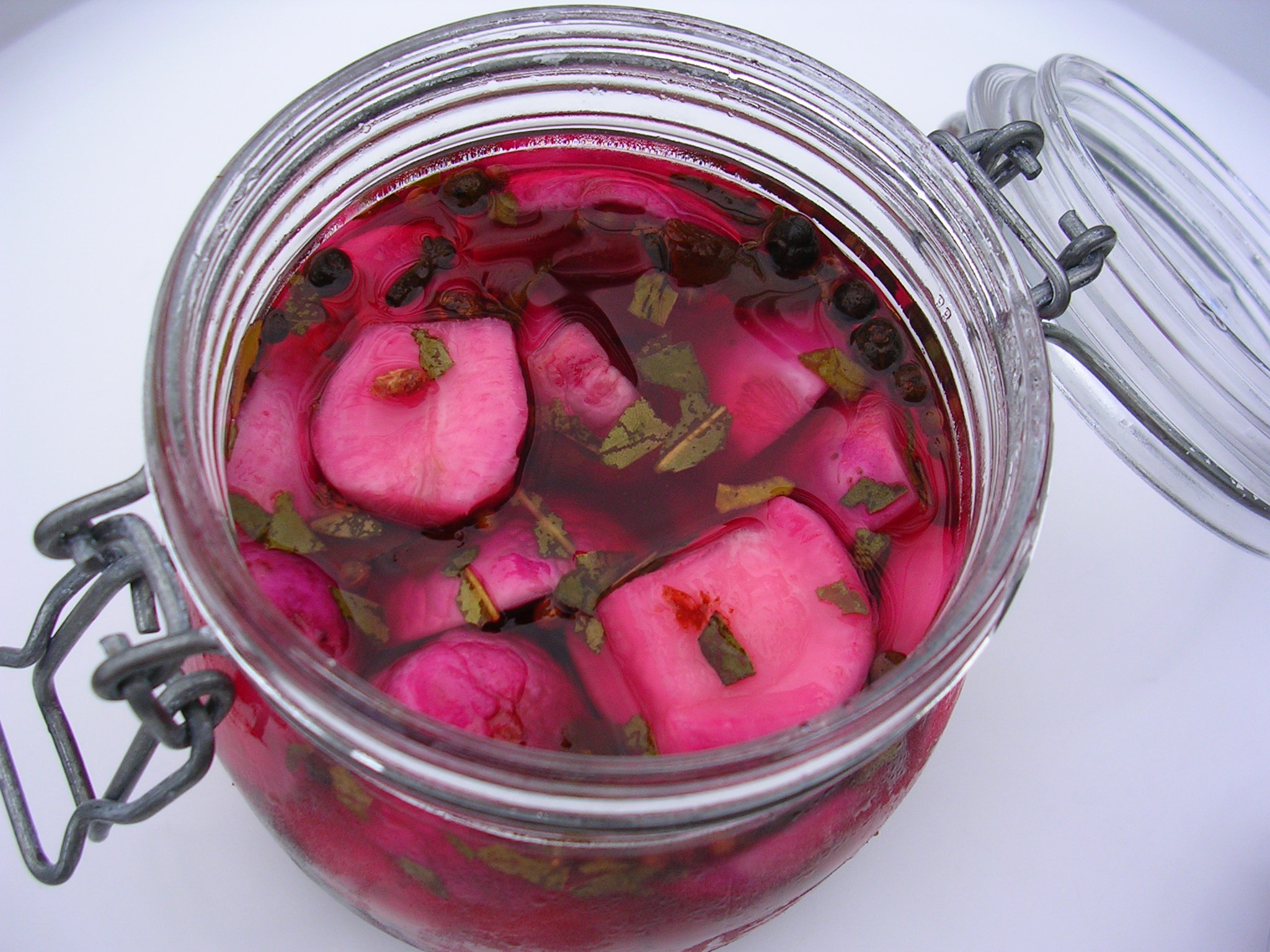
All of the radishes in the garden had to go because I needed the space. It was a large bunch, more than we could eat right away, yet just enough for a small jar of pickled radishes. My initial idea was to make something like Egyptian torshi, bright pink turnips and beets in brine, but then I settled for a sweat-and-sour pickling liquid.

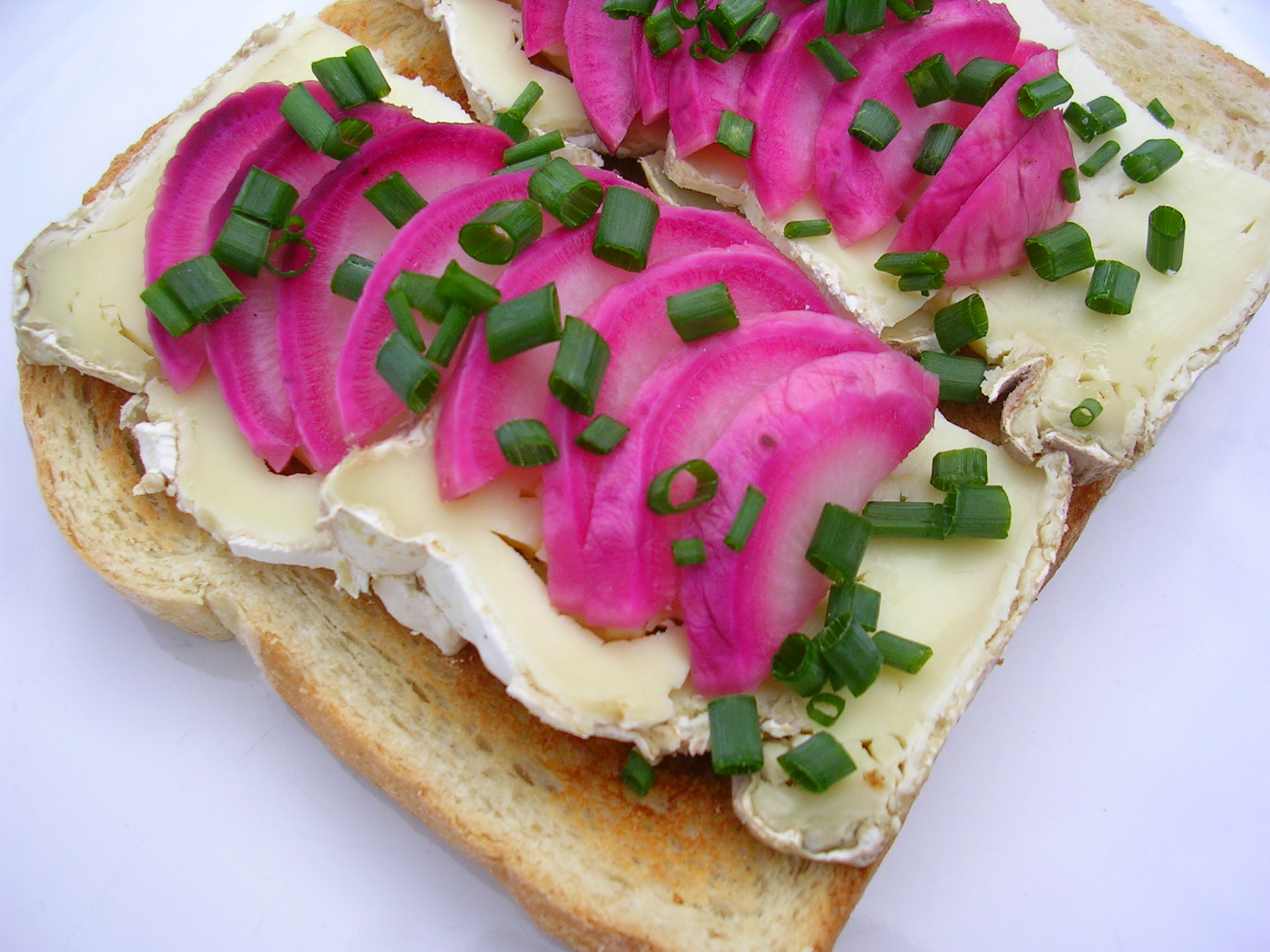
This is a „short-order pickle“ – one that should be eaten within a couple of days. The radishes do get wrinkly but that’s just looks. A word of caution: the smell is quite strong, although not much stronger than a good ripe cheese. The two of them taste good together, too.

Pickled Sweet-and-Sour Radishes

1 large bunch radishes (12 if big, 20 if small)

½ cup white wine vinegar

¾ cup sugar

1½ teaspoons salt

3 teaspoons pickling spice

1. Remove the leaves, root end and root hairs from the radishes. Brush under cold water and dry.

2. Leave the radishes whole if very small, or half/quarter them depending on size. I prefer cutting them to make sure they don’t contain any worms.

3. Pack in a jar with a tight-fitting lid. Place the jar on a folded damp kitchen towel (that prevents it from cracking when you add the hot liquid).

4. In a small pot, bring vinegar, sugar, salt and pickling spice to a boil, scraping down the sides and stirring, until the sugar is fully dissolved. Pour the hot liquid with the spices over the radishes. They should be fully immersed; add more vinegar and sugar in the same ratio if needed. Let cool, then close the jar tightly. Refrigerate for a day before eating.

Vanishing seeds

As a gardener, you experience all types of failures. What just happened to me with the cucumber, summer squash and Charentais melon seeds qualifies for the funny category although it is also rather annoying, because I started the seeds late already due to cold weather, and now I have to buy seedlings in order to get an early summer crop.

After the seeds showed no sign of germination after more than a week, I put the tray with the jiffy pots in the oven with the light turned on, and a heating pad underneath to speed things up. A big red sign said, “Do not use oven and leave light on”. The oven smelled like a greenhouse but except for a couple of lonely melon seedlings, no results.

So this morning I decided to start all over again, emptying out all the pots and sifting through the soil. I found several melon seeds that had not germinated, I suspect due to lack of heat. But I could not believe my eyes when the rest of the pots contained no seeds whatsoever! Then it dawned on me – one sunny day last week, I had put the tray outside on the patio table, and the birds must have eaten them.

A small consolation: there is still one jar of Golden Zucchini Chutney in the pantry. I made it for the first time last year instead of the Zucchini Relish I usually make. The recipe is adapted from Preserving by Oded Schwartz. We eat the chutney with any type of Indian food.

Golden Zucchini Chutney

3½ pounds golden zucchini

3½ tablespoons kosher salt

1 teaspoon corn oil

3 tablespoons black mustard seeds

1½ tablespoons freshly ground coriander

1 dried medium-hot red chili

1½ tablespoons turmeric

4 large onions, halved I thinly sliced

7 large carrots, peeled and grated

8 ounces candied ginger, finely chopped

6 garlic cloves, finely chopped

1½ teaspoons freshly ground black pepper

5 cups apple vinegar

1¾ cups sugar

You also need:

A canning pot, or a very large stockpot

6 1-pint canning jars

6 bands

6 new (unused) lids

1. Cut the squash (do not peel if using organic) in half lengthwise and scrape out any seeds. Cut into ½-inch cubes.

2. Place the squash in a colander and sprinkle with half of the salt. Let stand for one hour. Rinse under cold water and drain well.

4. Heat the oil in a large non-corrosive pot. Add the mustard seeds, coriander and chili and fry until the mustard seeds pop and the spices release their flavors. Add the turmeric and stir.

5. Add the squash with all of the remaining ingredients except the sugar and the remaining salt. Bring to a boil, reduce the heat and simmer for 25 minutes, or until the vegetables are soft.

6. Add the sugar and salt and simmer for 1 to 1¼ hours, until most of the liquid has disappeared and the chutney as a thick consistency. Remove the chili.

7. Fill into sterilized canning jars and process in a boiling water bath for 15 minutes. Let sit for 2 months before opening.

Makes 6 1-pint jars